
Polio (Polioencephalomalacia) and Listeriosis (also referred to as “Listeria”) are two, unfortunately, highly common neurological illnesses in goats. Often when we hear about one, we hear about the other, because they appear very similarly. So much so that many people just refer to the issue as “polio/listeriosis.” When they treat for one, they also treat for the other. But there is actually a big distinction between these two illnesses, and I want to discuss that before getting into the treatment(s). While these issues can be treated simultaneously to confirm you cover all your bases, it is important to understand each illness individually. I feel that these two diseases, but especially Listeriosis, are highly misunderstood in the goat veterinary community. Actually, Listeriosis has one of the worst treatment prognoses according to many veterinarians and establishments. According to NC State Extension Publications, “There are no effective treatments for small ruminants, and they usually die after infection. Large doses of penicillin may help in some cases.” As mentioned in the Merck Veterinary Manual, “death may occur 24–48 hours after onset of clinical signs; however, the recovery rate can be up to 30% with prompt, aggressive treatment.” While this may sound like a glimpse of hope, a 30% recovery rate is quite a grim outlook in my opinion. Both of these statements do not sound very helpful, in fact, they sound quite distressing! While Listeriosis is a serious disease, my special approach as an emergency consultant has had a very high success rate in treating it. I rarely lose an emergency goat client to Listeriosis OR Polio.
Let’s discuss Polio first. What is Polio?
Polio in goats is not the same thing as Polio in humans. Polio in goats is an acute Thiamine (Vitamin B1) deficiency. The rumen produces Thiamine naturally, however, deficiency of Thiamine, and therefore Polio, can still occur randomly. Some possible causes for Polio are:
- An “off rumen.” Diet changes, improper feeding, other illnesses, and any digestive issues can throw the rumen off. If the rumen is off and not producing B vitamins, Polio can occur.
- Thiamine disruptors. Certain medications, namely the coccidia medication “CoRid” have been known to cause Thiamine deficiency. Frequent exposure to antagonists to Thiamine, such as Sulfur, can also lead to Polio.
While these are two likely causes, Polio can appear seemingly randomly, or “idiopathic” in nature.
Next, what is Listeriosis?
Listeriosis is a disease caused by Listeria bacteria. This bacteria normally finds its way into goats’ bodies through moldy hay or feed. Listeria can be also be contracted through contaminated soil, as well as old hoses harboring the bacteria.
Now, to discuss symptoms…
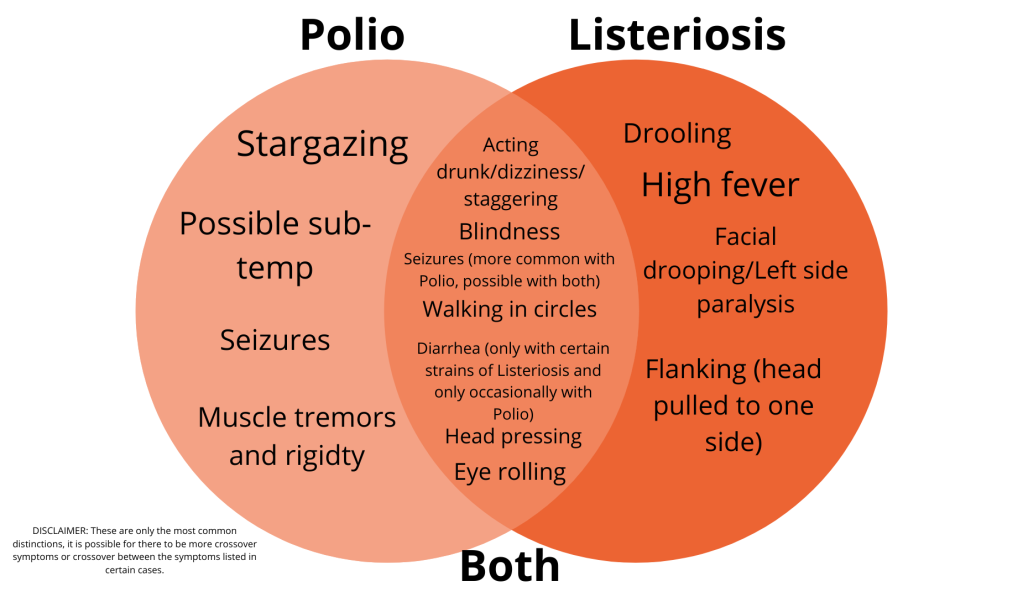
The symptoms of Polio and Listeriosis can appear quite similar as both involve neurological symptoms. The neurological symptoms can vary and be interchangeable…though there are a few classic differentiating symptoms between the two. Here is a Venn diagram of my observations (after treating many, many cases of both). Please do not expect each case to always look the same, and don’t discount an issue if one symptom does not match. These are just general observations! Always treat for both disorders unless you are consulting with someone knowledgeable enough on the topic to guide you to only treat for one! We will get into treatment in a moment.
Treating Polio and Listeriosis:
The treatments for both are different, but again, I do recommend treating for them together to be extra cautious.
My treatments for these issues are based on seeing them at a frequency most veterinarians and goat producers may never see. Consulting as a mentor for emergencies worldwide has allowed me to refine my efforts in treating these conditions.
POLIO TREATMENT:
Treatment for Polio is the dosage of high concentrations of Vitamin B1: Thiamine. Injectable Thiamine MUST be used as opposed to oral dosing. The dosage that I recommend for the best prognosis of this illness is a minimum of 500mg Thiamine SubQ every 4 hours round the clock. Round the clock means no matter what, even at night. Thiamine is a vet prescription med. Thus, many people don’t have access to it. For most of the cases that I treat, I use Fortified Vitamin B Complex Injectable. This contains thiamine. However, the concentration of thiamine is less than 500 mg/ml. This is not a problem, you just need to adjust the dose for that. The one I like to use contains 100 mg/ml thiamine – which means you need to dose 5ml to get the minimum of 500mg. I like to ensure the minimum of 500mg is reached no matter the goat’s weight. However, in larger goats you can up the dose even further. If the goat is over 100lbs, I recommend adding one extra cc for every 20lbs. If your B Complex has an even lower concentration of thiamine, you will need to extrapolate the dose to reach the 500mg minimum (i.e., a 50 mg/ml strength solution will need 10cc to reach 500mg). Improvement is often noted quite quickly after intervention. Do not be fooled by this improvement and stop treatment. Treatment must be continued at least 24 hours after ALL symptoms are gone. However, after some improvements are shown, you can switch from every 4 hours to every 6 hours. After a few days, if still on the upswing, you can begin to expand the time in between treatments even more. However, I recommend going for at least a one week minimum of dosing Vitamin B at least twice daily, even if the goat makes a full, fast recovery.
Goat Mentor EXTRA’s:
Make sure to dose cayenne hourly at the beginning of treatment, and then a few times per day as the goat improves. To dose cayenne, combine with raw organic honey and rub on the goat’s gums. Cayenne has readily absorbed B vitamins in it, and will also support your goat’s body in many more ways.
Dexamethasone or Banamine can be added to reduce the brain swelling and pain from Polio for a quicker recovery. DO NOT use both, choose only one. The decision between the two depends on the goat (i.e., do not use Banamine if the goat is having trouble with temp going lower-than-normal; do not use Dex if the goat is pregnant or is a young kid, and so on according to the safety precautions for each drug).
See note for supportive care with Listeriosis, as it will apply to Polio as well.
LISTERIOSIS TREATMENT:
Despite the fact that Listeriosis is reportedly susceptible to multiple types of antibiotics, I truly believe that currently the only antibiotic that will effectively treat Listeriosis is Penicillin. Many vets believe that oxytetracycline treats Polio, though I have seen it fail multiple times. I even once observed a vet dose both oxytetracycline AND penicillin—which is not a good idea as those two antibiotics should not be combined (leads to ineffectiveness). Stick to Penicillin. However, you are not going to be using it how you normally would! Dose Penicillin at a rate of 1cc per 10lbs, every 4 hours round the clock. Only switch to every 6 hours after significant improvements have been made. Many recommend dosing it IM, which is acceptable. However, I find it to be just as effective and possibly even more so when dosed SubQ. I have not seen it work effectively when given IV (intravenously). Additionally, a medication for the brain swelling is extremely helpful. As said above, Dexamethasone OR Banamine could be used—but not both. Usually I choose Banamine (used at 1cc per 100lbs SubQ) because Listeriosis presents with a high fever, and I want the fever reduction effects from the Banamine as well. Similar to Polio, continue treatment until 24 hours after all symptoms are gone (but never stop sooner than a 5-7 day course of penicillin, that is a required minimum no matter what). Listeriosis will not improve as quickly as Polio will. Some goats go 10-14 days before really making improvements. Don’t give up!
Now for the Goat Mentor EXTRA’S that I believe change treatment prognoses:
Add garlic! I always make sure my Listeriosis ‘patients’ get at least 3-4 cloves of garlic per day of treatment.
It’s all about supportive care. You can read however many vet manuals you’d like, or take your goat to the best vet there is, but not many (probably not ANY) are going to understand that supportive measures, not just the forefront treatment, are just as important. Not only should you dose your goat with cayenne as said above for Polio—which is always vital and makes a huge difference, but supporting your goat by keeping them fed and hydrated is very important. I like to use a combination of goat electrolytes and dark beer. I know beer may sound a bit funny, but I truly believe it is vital for listeriosis treatment as it provides hydration, calories, and rumen support via natural microbes. Not only can you start to drench these two for hydration, but it is best to make a complete slurry for support. This is priceless, and helps in cases of both Listeriosis and Polio, but I find it extra necessary for Listeriosis as goats do not make very quick turnarounds. Treatment may need to be continued for a while, leaving the goat weak in need of support and nutrients. To add more nutrients, make a smoothie with dark beer, electrolytes, soaked hay pellets and/or dark leafy greens like kale and romaine lettuce, applesauce, mashed banana, pumpkin puree, honey or molasses, carrot, celery, and make sure to add extra cayenne and raw garlic to this as well. Feed carefully with a drenching syringe, or a turkey baster if it is quite thick! Add Dyne High Calorie Liquid drenches for long-term support that is needed with the long treatment plan for Listeriosis.
Both of these illnesses are extremely difficult to watch occur. They can be devastating. I think it is really important to mention the toll it will take on an owner as well. Not only is seeing your goat in this state emotionally painful, but the frequency of treatments is grueling. Round-the-clock treatments are never easy, nor is injecting your goat multiple times a day. Try to switch up the sides you inject on and the injection locations. Use 20 gauge needles for non-antibiotic meds that are thinner (18 gauge for antibiotics). Remember that if you are dealing with this, you are not alone. As an emergency care mentor and a general goat care consultant, people come to me for help with these kinds of situations—but I want to make note that support from talking to someone is vital as well. Even if you feel confident in your treatment regimen, don’t hesitate to reach out for that support to talk through what you are doing, have someone to update with good or bad news, and to get guidance.
Lastly, please SHARE this post! The goat community of farmers, owners, big-time producers, and even veterinarians should know the treatment approaches for these diseases that work time and time again. Help me to change the poor prognoses these diseases have been labeled with. Help me to redefine goat care, one step at a time!
DISCLAIMER: I am not a vet, nor am I a licensed professional. I am in no way a “goat expert” and my opinions are only that of personal experiences, and my insights shared are not medical treatment suggestions, care suggestions, or any directions for raising goats at all. I am simply sharing my own personal opinions. Any and all changes to your goats’ health regimen, care, etc. should be approved by a veterinary professional or licensed professional. I also believe that every goat owner has their own way of doing things, so just as my opinions are my own, and cannot apply to anyone else, your opinions are also regarding your individual goats, and I welcome you to share them in a kind, constructive manner. Disclosure: This post may contain Amazon Affiliate Links, from which I will earn a commission.

 The Giving Goat, LLC
Thank you so much for posting this. It’s extremely frustrating that the Vet I took my goat to did not know how to treat Listeriosis properly.
My 1 year old doe presented with symptoms of Listeriosis on 6/19, we gave her penicillin, dexamethasone and vitamin b complex with Thiamine around the clock every 6 hours and we started this within 12 hours of her showing symptoms. She is still with us today and almost completely back to normal! Her jaw is still slacked on one side and it’s difficult for her to eat on her own, we have been giving her pellets, puréed greens, goat electrolytes and minerals and some cut up hay. It’s been almost 6 weeks since she got Listeriosis and our new vet is hopeful her jaw will regain function. This post should be shared everywhere and be used as treatment for goats that present with symptoms for listeriosis/polio, my goat is living proof that this treatment works!
LikeLike
Hi Lisa! I’m very happy to hear this positive story! Thank you for sharing. Yes, listeriosis is highly misunderstood in the veterinary community. Great work with your doe. With time and supportive care, there is definitely hope that the neurological function can come back. Physical therapy, massage, acupuncture/acupressure, herbal (and essential oil) neurological support, and continued weekly B Complex can help with this more chronic neurological recovery. Feel free to contact me for assistance, but great work, truly!
~ Hannah
LikeLike
we have a goat with what we believe is listeriosis, the only differing symptom was increased salivating. We had given her 4 doses of pcn and 2 doses of vitamin b.. I believe we caught it too late and she is almost continuously seizing. With that said we have 2 other goats, should we treat them prophylactic with penicillin and b complex?
LikeLike
Hi Ashley,
Thank you for your comment. I am very sorry to hear about your goat. Is she still with us, despite the seizures? Please feel free to contact me for individualized help via email to thegivinggoat@gmail.com. Usually when I see listeriosis, it does not run through herds rampantly if the causative factor is removed. For that reason, I do not recommend prophylactic antibiotic use. If you are unsure what the causative factor is, then I would change just about everything – from bedding, to the type of hay you use, to new hoses for water and more. Your other goats can definitely receive B Complex injections, once or twice daily is fine. You can also add in goat probiotic gel and raw garlic for extra immune and rumen support. Monitor rectal temps 2x daily, and if anyone spiked a temp, that would be an early warning sign to start antibiotics. Loss of appetite, lack of coordination, and general lethargy count as well. I do prefer to advise when I have more background information, though, so I strongly urge you to reach out.
~ Hannah
LikeLike
This is extremely helpful! My poor goat is sick and the Ohio State University hospital did not have Penicillin G! So I’m stuck with Oxytetracycline. I’m praying he can pull through. I have tried so many vets to see about getting the best medicine with no luck.
LikeLike
Hi Shannon,
Thank you for your comment, and I am glad this post has been helpful for you. I am very sorry to hear that the Ohio State University is using Oxytetracycline, as despite documentation (such as the Merck Veterinary Manual) suggesting that it can treat Listeriosis, I have personally not seen it treat the illness effectively. Most likely, the hospital does have Penicillin, but has chosen not to use it. However, you can still make sure that they are doing the necessary supportive measures, including fluid therapy, TPN, thiamine, and Dexamethasone.
Feel free to email me to talk more (thegivinggoat@gmail.com)
~ Hannah
LikeLike
Hi! I have a one year old doe that has been diagnosed with listeriosis. I noticed she was laying around and not really herself for a few days but it was super hot here, I brought her inside our basement and checked her temp and it was 105. I have her a Vit b complex injection and some children’s Motrin. The next morning she was no better so I called my mom to take her to the vet since I had to be at work. By the time she got her to the vet she was circling, drooling and one side of her mouth was droopy. They sent her to the animal hospital and keep her from Tuesday-Saturday and gave her penicillin, batamine and thiamine. They called me to tell me she has stopped eating and wasn’t getting any better and that I needed to put her down. I went and picked her up thinking I would get to love her on her for awhile and then have to put her down. When I got her home she was walking, grazing and acting somewhat normal. I kept her on thiamine and started her on LA-200 as that’s all I have and I can’t find pen G anywhere in stock. I added garlic to her diet, probios, and some dark beer (but she’s really not a fan) she’s eating, drinking, up walking around. Her only remaining symptoms are a tremor and she’s still kinda weak. What should I be doing for her at this point? Should I continue the b1 and La? I’ve had her home 4 days at this point.
LikeLike
Hi Tara,
I would love to assist, but it may be better if you send me a message on Facebook Messenger (The Giving Goat Natural Goat Care & Blog) or Instagram (@goatlifegoodlife) for rapid replies. It sounds like she is improving, which is positive, but without being on Penicillin at the goal amounts/frequency, if it is listeriosis she is still at a high risk for a boomerang effect.
Please send me a message!
LikeLike
Thank you so much! One of my goats got diagnosed with Listeria 4PM today, and I must admit, she is responding to this care! Our vet set her up with all subQ antibiotics (Nuflor, not penicillin, once every two days for 3 doses total) plus Dexa (a total of 3 doses, once a day for 3 days), LA-200 (a total of 3 doses, once a day for 3 days), and Thiamine (a total of 6 doses, twice a day over 3 days). We are making sure she is upright in her body while lying down, and built up straw around her to keep her warm. We’ve got a light flannel blanket on her over straw on top of her, with the blanket tucked in around her collar (it’s freezing out).
She started showing symptoms two days ago, but today is when she started drooling and showed balance issues, so I called the vet right away. Later before the vet got here I saw her get knocked down by another goat (just bumped into), so she seemed to be declining rapidly this afternoon.
After the vet and the initial doses of all the meds, I found your article thank God. I’ve been rubbing her gums with a mixture 1/2 tsp cayenne, 1 tsp raw organic clover honey, and 2 tsp organic molasses; been doing that every hour, 3 hours so far. I was shocked at how eager she was to get it, and by the second hour she was sucking on my finger. As her tongue didn’t work right earlier, I took that as a good sign.
For the every 4 hour feeding, I mixed this together: (three feedings worth, I’m guessing, so I’ll be mixing this up twice a day)
… 8 oz dark beer
… 8 oz water with 1/2 tsp salt for electrolytes (Himalayan pink salt)
… 1 oz pumpkin pie filling (the only thing I could find with pumpkin at the store)
… 1 oz organic frozen bananas
… 1/2 oz kelp
… 1 oz organic goat feed (we mix it ourselves, soaked then pureed)
… 1 oz organic alfalfa pellets (soaked then pureed)
… 1/2 oz raw organic clover honey
… 1/2 oz organic molasses
… 2 cloves garlic
… 1 small-medium carrot
… 1 tsp cayenne pepper spice powder
It comes out literally looking like diarrhea and smelling awful! I warmed it up and took a bowl out with a spoon (the syringe didn’t work and I ended up getting it sprayed on the ceiling, lol). Remember to take a paper towel to clean up the drool on your goat! Anyway, she ate/drank it like it was a gourmet meal! That’s one thing I noticed, her ability to suck is much stronger than earlier. One of my other goats cleaned up the bowl after Creamy was done. My eyes have been watering from the garlic and cayenne (I never use either in cooking, so I am really not used to it), but I can see she is stronger. No guarantees, of course, but I feel like I am actually helping her.
Anyway, I wrote things down as recipes so that I can replicate them. If you have any suggestions or modification, please let me know!
Thank you again for making such a huge difference for Creamy. I’d rather nurse her and give her what she needs than just go to bed and hope she’s alive in the morning.
LikeLike
Hi Brenda,
Sorry to hear about the Listeriosis (though other differentials are still possible, like Polio), but I’m glad you’re on a good track with her.
While Penicillin is preferred, it is difficult to get for many vets right now. Nuflor is by far the next best, recent notes from Dr. Meredyth Jones confirms there to be some good reasoning behind its use for this issue. I would strongly suggest it is given every day. Listeriosis treatment should be aggressive, so the standard dosages for all antibiotics are to be altered. I would do Nuflor once per day for 5-7 consecutive days at minimum, and if LA200 is on board too, ideally it would be once per day for the same duration. If your vet can prescribe more to you, I would urge them to, citing that standard Listeriosis protocols require more rigorous treatments. The Thiamine sounds good – but you will need to continue with B Vitamin support for longer, so get some over-the-counter Fortified High Level Vit B Complex with 100mg/ml thiamine. This is a perfectly suitable replacement, as stated in my post.
I think that your goat slurry is a little bit “much.” While it’s an automatic instinct to increase nutrients as much as possible, that isn’t quite ideal. Remember, her body is compromised, so her rumen is compromised. It will not be fermenting and digesting at the normal function or rate. Excess grain products, carbohydrates, or anything really, could build up in the rumen. Often “down goat slurry” recipes can be found undigested in goats who were ill and pass away. and sometimes are the cause of death due to bloat or acidosis from the lack of proper digestion. Giving it in a slurry is even worse, as when we remove chewing from the equation, we also remove salivary production which is a necessary digestive factor and buffer for rumen acid. So, the recipe is high risk for causing acidosis or similar issues. Here is how I would modify:
– Beer is fine, I like to limit it to 6-8 oz twice per day, though. Not sure how you are mixing and dividing the recipe so I’ll leave those calculations to you.
– Water is better first mixed with commercial electrolytes such as Bounce Back or powdered Goat Electrolytes, salt alone is not good to just throw in there. Alternatively, some pedialyte can be a good water + electrolyte hydration factor to use, perhaps 50/50 with pure water.
– No pumpkin pie filling. The sugar and the evaporated milk and cream is not good for her. You can omit a pumpkin element (applesauce would be a good replacement), or buy a sweet potato and bake it until soft and use a spoonful of this.
– Bananas are okay, but keep it in a low quantity.
– The kelp may be better offered to her free choice, so she can take the quantity she feels she needs, but I am okay with mixing some into the recipe on a short-term basis (don’t want to overdo the iodine).
– I would not recommend mixing goat feed in. Sometimes I will if there aren’t other options for nutrition, but again, anything we can do to prevent acidosis is helpful.
– Alfalfa pellets should be the staple of the slurry! Perfect!!
– Honey, molasses, garlic, carrot, and cayenne are all great. You can add some leafy greens like romaine lettuce, or a little bit of a bell pepper. Celery is nice too. These veggies are more fibrous and will help stimulate the rumen more than soaked grain and pumpkin.
Be sure to include store bought goat probiotics in her regimen – i.e. Probios Bovine Gel.
Hydration is really important, so there should be a few dosings throughout the day of just goat electrolytes (water + commercial electrolyte solution), spaced in between the nutritional slurries.
The second she shows a bit more chewing and swallowing ability, try to get some longer stem forage into her. Handfuls of grass, chopped up hay (with scissors, or soaked hay CUBES for horses), or some goat-safe leaves. We want to get the rumen back to functional digestion as soon as possible.
Please keep me updated, I keep track of as many Listeriosis cases as possible to add to my personal research. I am available via email to thegivinggoat@gmail.com
~ Hannah
DISCLAIMER: I am not a vet, nor am I a licensed professional. I am in no way a “goat expert” and my opinions are only that of personal experiences, and my insights shared are not medical treatment suggestions, care suggestions, or any directions for raising goats at all. I am simply sharing my own personal opinions. Any and all changes to your goats’ health regimen, care, etc. should be approved by a veterinary professional or licensed professional.
LikeLike
Hi. We are on Day 10 of treatment. Hindsight i think we started a day late. Sunday morning goat was more vocal than usual, by evening she had her head in the corner of her shelter (but we have about a foot of snow on the ground and she doesn’t like being in it) she came out for us to hand feed her fruit and veggies, she did circle a few times and we didn’t realize it was a symptom at the time, then Monday the circling became more noticeable with a head tilt, called the vet and started treatment, per vet, Monday evening of 10cc pen IM 2/day; 2cc dex IM 1/day; vit B 2cc SubQ 1/day; melixicam 3 pills once a day. 100 (+ish) lb goat, (not sure of age >4 yrs?) keeping her inside to treat, temps are below freezing outside.
She was weak and started to stumble some from excessive circling, but Goat has not been “down” yet, we did administer SubQ fluids early on as precaution/as needed, but she is eating (Timothy pellets and hay, I stopped the grain) and drinking on her on (between circles and sometimes we need to guide her head to food/water), normal urination and bowl movements. We still hand feed her fruit and veggies, including garlic and drenching the beer slurry daily. Circling becomes more aggressive and just pivoting on the back legs.
Day 7 treatment (after research) we upped pen shots to 3 times a day (with jobs it’s just not possible to do every 4 hrs) and vit b to 5cc 2/day.
Day 8 treatment, circles are walking circles, not pivoting. that evening she was walking straight lines, getting into things, normal behavior, we thought it was over, continued treatment and day 9 was back to circling/pivoting, that was a huge blow to us, as we are already struggling with giving the shots and the vet recomending setting a timeline and offering euthanasia on Day 10.
Day 10, no change. Still circles/pivoting, she does straighten head, but always tilt when circling. Still has reaction/blinking to both eyes, moves affected ear when I hold it or randomly. Has lost NO strength, especially when we administer shots. Only issue is circling and she doesn’t want to go outside or walk (she walked with me almost every day).
Should we increase the dex or melixicam? Any oral medications we can supplement with? She is such a tough goat, but so many shots are heartbreaking. Vet does not think she’s in pain, I don’t want her to suffer.
Will the circling go away? This isn’t some lasting effect? What can we expect going forward? This has taken a toll on us a well. I spend every extra minute by her side.
LikeLike
Hi Sheri,
I just sent you an email!
~ Hannah
LikeLike
I have a 6 week old baby, showing sign of polio, bleating, head in the corner acting dazed. Administered Thiamine (1/2 cc)every 12 hours as suggested by the vet for 3 days along with dex (1cc), a dose of NuFlor and Bayrtil for signs of upper respiratory infection as well. We were seeing clear signs of improvement but 24 hours from the last dose of thiamine she went back to the original symptoms. I immediately started the thiamine again, just yesterday.
To find some other help I found your article. Do I administer the thiamine every 4 hours as you recommended for her, should I continue the dex as well? I can start the cayenne and honey as well. She was on creep feed with the other kids but prefers the alfalfa, do I pull the grain all together? She is still nursing. Any help for this young doe is appreciated.
LikeLike
Hi Kari,
I sent an email to the address attached to your profile. This is something to discuss further one-on-one!
~ Hannah
LikeLike