Gone are the days when we can consider chemical deworming the “effective” approach and natural/holistic deworming the “experimental” or “unreliable” approach. Due to dewormer resistance, the efficacy of all deworming tactics, including chemical dewormers, is variable and often poor. Integrated Parasite Management (IPM) involves the use of multiple techniques to form a comprehensive prevention regimen and thoughtful treatment plans. There does not need to be a line drawn between holistic concepts and conventional drugs, because they can complement one another in a complete, integrated regimen.
One of the simplest ways to learn about IPM is breaking it into the following sections:
1. Pasture-Level IPM
2. Herd-Level IPM
3. Worm-Level IPM
- Pasture-Level IPM
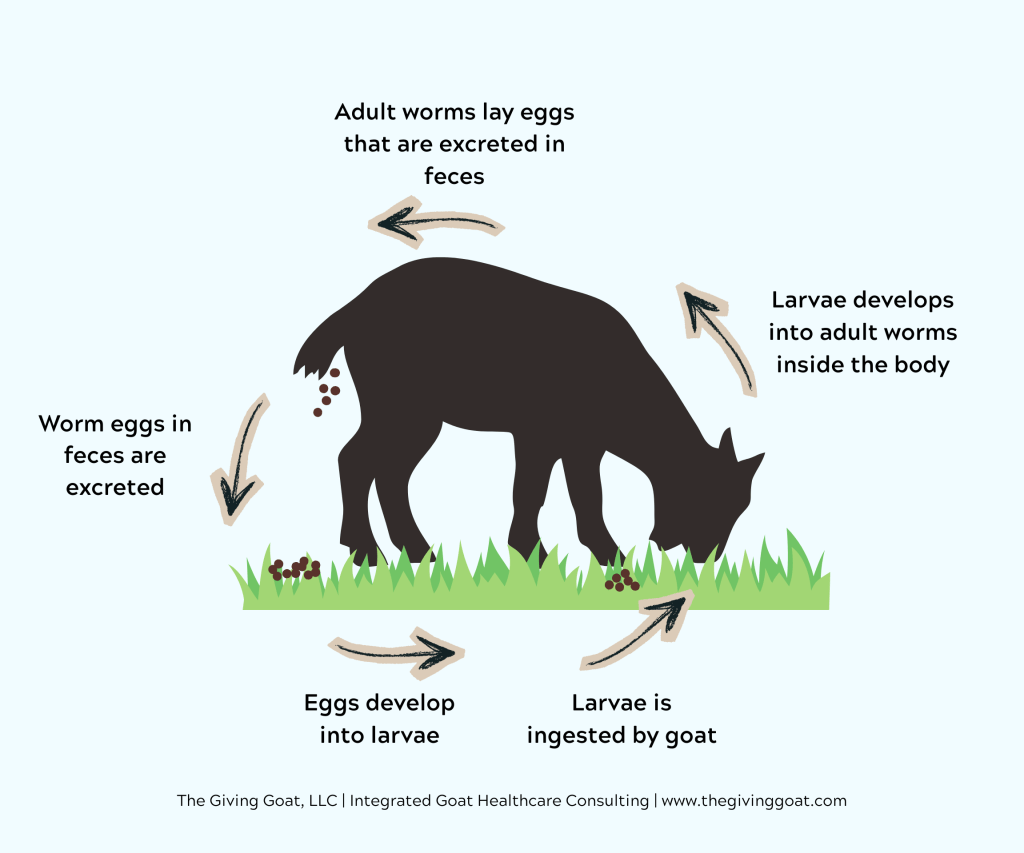
Grazing is one of the best ways for parasites to re-infect goats and complete their life cycles. Goats are made to browse above ground level, thereby consuming weeds, branches, and other forages besides grass. When we force goats to a ground level grazing environment, we increase the amount of worm larvae they consume. Put simply, goats poop on pastures, and the climate and moist grassy environment allows the larvae in their stool to develop and become infective larvae. Then, goats continue to graze on the larvae-infested grass, and ingest infective larvae that mature into adult worms, which then lay eggs that become larvae.
Some things can be done to reduce the reinfection rate on pasture:
- Rotational Grazing
Rotational grazing means moving the herd at specific increments to allow time for pasture to rest. This can reduce the quantity of feces in a small area of grass, keep grass height higher (discussed momentarily), and more importantly, help stop the completion of the parasitic life cycle. If animals are moved prior to consuming infective larvae, and the larvae are without a host, they will die. Unfortunately, in prime weather conditions for larvae survival (moist, warm, or even cool) this can take a long time. It is unlikely all larvae will die with most rotational grazing techniques, so the life cycle is never entirely halted. That being said, any type of rotation is better than no rotation. Some options for rotation include:
Intensive rotation = move herd every 3-7 days (4 days being ideal), and do not return herd to a pasture until at least 30 days has passed (more ideally, 45-60 days).
Simple rotation = divide pasture into 4 sections and rotate weekly (in order), thereby returning to the initial pasture and subsequent pastures after a 30 day rest period.
Options between these methods are also worth exploring. Some can only rotate between two pastures every 30 days. While this is less helpful for larvae control, it can still help with grass height and density of manure. In general, larvae can survive for 1, 2, or even 3+ months in the right conditions, so don’t spend too much time trying to halt the life cycle–anything is better than nothing.
- Pasture Height
As discussed briefly earlier, keeping pasture height higher can be beneficial. Larvae migrate up moist stalks of grass, but can only get to a certain height. Grass should be kept above 4-6 inches, ideally 8-10 inches. If grass is 4 inches or below, the larvae ingestion risk is much higher.
- Cross-Species Grazing
Consider putting horses or cattle on pastures either with small ruminants (if deemed safe) or during the rotations, as they will consume small ruminant parasite larvae without becoming infected.
- Stocking Density
Ensure that herd size is reasonable for the space that you have. Too many goats in too small of an area will create more feces and overgraze, increasing parasite reinfection rates.
- Fence-Off Wet Pasture Areas
If water often accumulates in low areas, keep the goats away from that. Additionally, always fence off ponds or streams as these can cause different (and even more detrimental) parasitic infections. Moisture is a big part of parasite life cycles, and more damp grass is preferable for larvae.
- Plant High-Tannin Forages
High tannin forage has been proven to assist in parasite management. These can be seeded in your pastures, and might include Sericea Lespedeza, Chicory, and Birdsfoot Trefoil.
- Consider Dry Lots
Many of us do not have acres of grazing space or a herd of horses or cattle to co-graze with. That’s fine! If your pasture is problematic and you can’t do anything about it… get rid of it! Dry lotting is a perfectly sound option for goats, because most of their nutrition comes from hay.
- Never Feed Hay or Other Things on the Ground
While this isn’t pasture-related, it’s always important to keep hay, feed, and minerals elevated. If it could come in contact with hooves, it is coming in contact with feces, which means it is infecting animals with parasites!
2. Herd-Level IPM
Herd-Level IPM focuses on what you can provide for or do for your animals. First, let’s talk about the foundation of Herd-Level IPM:
In my opinion, the foundation of an IPM plan begins with the animal’s genetics and general health. Certain breeds or individual goats may be more resilient or resistant to parasitic infections. Resilience is the ability to withstand infection (have a parasite load but maintain good health), while resistance is the ability to limit infection (maintain low levels of parasites/clear infection). Both are important factors that can be selected for when breeding goats. The longevity of a parasite management plan relies on producers breeding goats with superior genetics. If you are not a breeder, but simply own goats, you cannot change genetics, but you can focus on overall general health.
Good nutrition, a healthy rumen, and a strong immune system, all play a role in resistance and resilience. A forage-based diet is the baseline of good health, with adequate mineral supplementation (especially the vital three trace minerals: copper, zinc, and selenium). Mineral or nutrient deficiencies increase susceptibility to parasites. Presuming the standard healthcare and nutrition needs of a herd are satisfied, one must then consider how the goats are being managed.
Some options for Herd-Level IPM include:
- Copper Oxide Wire Particles (COWP)/Copper Boluses
Copper boluses are a proven method of lowering FECs (fecal egg counts). The American Consortium for Small Ruminant Parasite Control has published multiple resources on the topic, and they can be found on the following webpage: https://www.wormx.info/copper-oxide-wire-particles
Presuming that there is room in the diet for additional copper, copper boluses are a safe method of parasite control. There is usually room for additional copper via copper boluses, but I always make note of this in case you have dosed injectable or oral mineral supplements beyond a loose mineral, or happen to have naturally-occurring high copper levels. You can click HERE to access a copper map to see areas of the U.S. naturally high in copper, but remember that this doesn’t necessarily mean you cannot supplement with more copper. Even if your hay is grown in this area, there is no guarantee that your hay itself is high in copper, and if your goats aren’t consuming a large quantity of other deeply-rooted forages that are pulling copper up through those roots, your goats may not be consuming as much copper as you think.
Most of the studies on copper boluses have actually been done in sheep, a species that is highly sensitive to copper toxicity. So on that note, we can extrapolate the safety for goats and feel even more confident in copper bolus use. These rods are slow-release, so while they are dissolving in the abomasum causing worms like Barberpole to die off, they are only raising liver copper levels gradually.
When using copper boluses as a dietary supplement to correct deficiencies, the boluses can be opened up and the rods can be fed in a treat without compromising efficacy to a notable level. However, if using them to aid in parasite control, I recommend “pilling” them with the baling gun so that they can reach the abomasum and correctly lodge there. Dosages range in the research, but it has been determined that dosages as low as 0.5 to 1 gram are effective in kids, and 1-2 grams can be given to adult animals. The 4 gram dosage is deemed too high for deworming purposes (should only be given to correct copper deficiencies). These low dosages can usually be repeated as frequently as every 6 weeks during “parasite season.”
- BioWorma
BioWorma is a feed supplement made from a fungus called Duddingtonia flagrans. The fungi’s chlamydospores pass through the digestive tract, forming a network of hyphae to trap and inhibit worm larvae in the stool. This process can cause the destruction of worm larvae prior to the point of reaching the infective stage. Interestingly, this technique has some cross-over with Pasture-Level IPM, because it is ultimately targeting the stool and larvae, even though it is fed orally to the animal. Often I am asked if a pasture can be treated with something to clear larvae. The simple answer is unfortunately, no. However, BioWorma is the closest solution. BioWorma can be fed to inhibit larvae for dry-lotted goats as well. Significant research has also been done on BioWorma to prove its efficacy. This factsheet and this research abstract have been provided by the ACSRPC. BioWorma can be added as a feed topper. Despite its expensive price tag, the dosage is quite low, so re-purchasing is infrequent.
- High Protein Diet and Condensed Tannins
Increasing dietary protein, while not necessary for most dry goats, has also been shown to help small ruminants with parasite resistance and resilience. When applicable and safe, the addition of alfalfa or another legume may be helpful for susceptible animals. On that note, one legume that can be added is Sericea Lespedeza. Not only can this be grown in a pasture as mentioned earlier, it can also be purchased as a pellet or hay. The high condensed tannin content of Lespedeza may provide another layer of parasite management alongside its higher protein content. With that being said, always consider if the diet allows for an increase of protein and calcium before adding this in (male goats may not be able to tolerate it).
- Herbal Supplements
There is significant debate regarding the use and efficacy of herbal supplements. While I hope further research is done to illuminate opportunities for using natural supplements for parasite control, most information is currently anecdotal. With that being said, I am often perfectly happy to work from anecdotes presuming the idea is generally safe and reasonable. Multiple herbal deworming formulas are on the market. As someone who has studied herbalism (self-instructed) for many years, I have tried multiple formulas with my own goats and with my clients and determined some general opinions.
Land of Havilah’s Parasite Formula and Fir Meadow LLC’s two formulas (DWA & GI Soother combined) both have varying degrees of “success” in practice. While I have seen some egg counts significantly lower following the use of both of these formulas, we are unfortunately not keeping a controlled environment that reduces the possibility of external factors having an impact. However, based on my observations, they seem quite safe, and I especially see how they may have more indirect immune boosting support as opposed to direct deworming mechanisms. That is still beneficial, because the stronger the animal is, the more resilient and resistant they are. In fact, it could also be coming down to the herbs in these formulas providing some extra vitamins, minerals, and nutrients that are strengthening the animal. In reality, we don’t know how they are working or if they are working, but I have seen enough positive results (both in overall health and lowered FECs) to recommend them. It seems that frequency correlates to anecdotal success as well, with reports of use for 3-4 days weekly in warm or moist weather being the best option, compared to once weekly or even less frequent. I personally follow a 3-days-on, 4-days-off regimen in my own goats, and if nothing else, they sure do enjoy the excitement of a special treat.
Other formulas such as those by Molly’s Herbals or Hoegger Farm Supply usually have fewer reports of success, from what I have seen in nearly a decade of trying these herbal methods.
Along with herbal supplements, there is a discussion on essential oils. Essential oils are far more research-backed, with studies in other species discussing oregano, cinnamon, or clove oils for coccidiosis control, or orange emulsion for Haemonchus in sheep. With that being said, the studies often use larger doses of emulsions (which are not equivalent to the small bottles of essential oils we can buy), and not all are in ruminant species (the rumen adds an extra layer of concern in terms of absorption ability and microbial impacts). In goats, the general consensus is to use low-dose concentrated essential oils anywhere from 1-3x weekly for potential parasite control. From personal experience and with my mentorship clients, my regimen to follow does appear to lower the frequency and severity of parasitic infections, without causing any clear, observable, adverse symptoms:
1 drop each of the following (high quality, food-grade EOs only)
- Wild Orange
- Oregano
- Clove
- Lemongrass
- DigestZen (DoTerra brand)
Occasionally, I will add Cinnamon, Thyme, or OnGuard/Thieves blends.
I combine this with 2-3ml of olive oil as a carrier and dose via oral syringe. For normal use, I dose this 1x weekly. For more rigorous use, I follow a 3 days on, 4 days off regimen.
Please note, many EOs are not safe for pregnant does, and the selection of specific oils and dosages must be done carefully. I am happy to discuss the regimens I recommend for pregnant does, but please do not use the regimen above without alterations.
In recent years, people have been inspired by my EO regimen and used it similarly, but in greater quantities or frequencies. What I wrote years ago still stands. I will not exceed the dosages listed in this article. Occasionally, I have seen adverse digestive effects (mostly due to rumen microbiota disruption) with some more extreme (multiple times daily) dosing. If you choose to exceed my preferred use, do so with an abundance of caution at your own risk. I am open to exploring options, but I am also conscious of the strength and safety concerns. Given my long-time use of this particular regimen listed above, I feel no need to alter the regimen for something that has higher doses if not necessary.
I also recommend the integration of other supportive natural foods and herbs. I am raw garlic’s #1 fan, and since it is safe for use in goats, I try to feed at least one clove, once daily. Many goats love it–though for some, we have to sneak it in. Garlic has proven immune boosting properties, and it is another one of those “why not” regimen additions for me. I can and will state that I have seen it make a difference, but without any solid research, the main thing I will say is “why not!” Give it a try! Other things such as oak leaves, pine, or pumpkin seeds, are rumored to have an impact, and all are safe to experiment with. Again, at minimum, you will have some happy goats enjoying some tasty treats.
Some natural methods that are either disproven or highly unsafe are Diatomaceous Earth (DE) and lye deworming. DE has been proven to have no impact on internal parasites, as it loses its properties for killing parasites once it is wet. With that being said, some speculate that higher doses of DE may result in drier fecal pellets, which could inadvertently impact larvae development. DE may be damaging to respiratory tissues if inhaled, and even when dry, DE poses a risk for causing stone formation in male goats (silicate-type). Lye deworming is an extremely risky idea, as lye is a caustic chemical that can damage skin and mucosa. Put simply, if you are giving lye at a low enough, diluted dosage that it is not causing harm to the animal, then the stomach acid that is neutralizing the lye is preventing it from forming an overly-alkaline environment that kills the parasites. On the other hand, if the lye remains effective and does produce that environment, it will also be tearing up the mouth, esophagus, and the gastric mucosa. There is no proven research that lye is a safe and effective dewormer, so please avoid this harmful and ineffective idea.
Overall, when it comes to natural/herbal supplements, I try my best to avoid confirmation biases when researching. I can easily search for studies that mention the use of something–such as orange oil–for small ruminant parasites, in hopes of finding a non-chemical solution. However, removing biases also means remembering that an orange oil emulsion in a high dose isn’t the same thing as essential oils, and that it was also just one study. I can find research that states that oregano oil treats coccidiosis in broilers, but that doesn’t mean it will do the same thing in goats. With that being said, this research can serve as inspiration to elicit more research and exploration (either on our own with observations and fecals, or in the industry).
3. Worm-Level IPM
Lastly, we must discuss Worm-Level IPM, which is essentially just chemical deworming. What is known to kill the worms? Anthelmintics! Anthelmintics such as Ivermectin, Moxidectin, Fenbendazole, Albendazole, and Levamisole are the most common for small ruminants. Unfortunately, all producers face significant anthelmintic resistance. We have seen a worldwide increase in resistance in relatively all livestock species, but especially goats. Anthelmintics–more commonly known as chemical dewormers–hardly work. Whether due to overuse, improper use (underdosing and more), or other factors, the efficacy of chemical dewormers is extremely limited, and it gets lower every time you use a chemical dewormer on your farm. Parasites are quick to develop genetic, population-wide resistances, even if the proper doses are used. Chemical dewormer stewardship is a primary concern, and we need to use the remaining effective drugs carefully and sparingly. This is why the rest of IPM is so vital, so that we can reduce the use of chemical dewormers and preserve their efficacy. The ins-and-outs of chemical dewormers, from dosing to resistances, is described in the following article within this parasite management learning pod: (Not-Yet Published)
Did you enjoy reading about IPM? What procedures do you implement? Feel free to leave a comment below, and remember that I am available for one-on-one discussion via the contact methods below:
Email: thegivinggoat@gmail.com

 The Giving Goat, LLC