
NOTE: the information in this article is constantly updated based on emerging research and personal observations. Please check back frequently for changes.
Last updated: 3/24/26
This article will explore general information on chemical dewormers, dosing information, dewormer resistance, FAQs, and more. The following is an outline of what to expect:
- Chemical Dewormers: Why & When
- Everything to Know About Dewormer Resistance
- Injectable Dewormers, Horse Pastes, and Pellets: Yay or Nay?
- Proper Dewormer Dosing Guidelines & Your Guide to Dosages
Chemical Dewormers: Why & When
Chemical dewormers (also known as anthelmintics) are used when goats have significant worm burdens that are impacting health, wellbeing, and/or productivity. Chemical dewormers are occasionally recommended to be used in prevention programs, but this is an outdated practice. Based on all updated research and directives, chemical dewormers should only be given on an as-needed basis.
What counts as “needed?”
Multiple factors may be used to identify a parasite issue:
- Fecal egg counts (FECs)
- FAMACHA scoring
- Body condition scoring
- Stool texture
- Coat health and general appearance
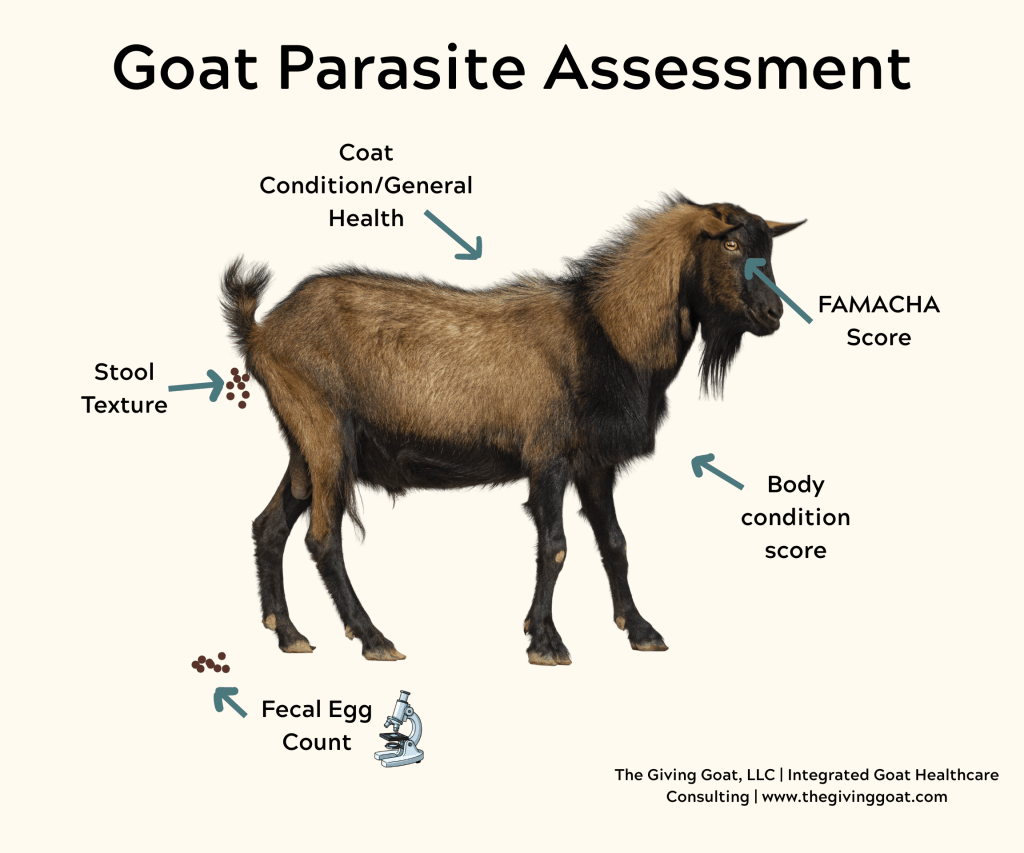
These factors are not extremely reliable on their own. It is best to consider multiple factors at a time to determine if there is a problem. For example, a high FEC may not impact FAMACHA, such as when there are many parasites present, but they are species that do not cause anemia. Comparatively, abnormal stool texture is not always due to parasites, and could be caused by dietary or digestive issues. Weighing these factors in relation to one another is the most effective way to determine if there is a parasite problem that requires deworming.
I am often asked what level of “Eggs Per Gram” (EPG) dictates that treatment is required. Unfortunately, there is no good answer for this. Every goat has a different level of tolerance. Facts such as age, life stage, and production have an impact. Additionally, thresholds vary depending on the species of parasite. Some require treatment for a positive result of any kind (Lungworm and Liver Fluke, for example), while others may not require treatment even for substantial egg counts if the goat is otherwise healthy. You can always reach out to me with your goat’s information and current fecal EPG to get a personalized opinion on the case, see contact information at the end of this article.
Click the image below to watch a short reel on Refugia:
Everything to Know About Dewormer Resistance
The overuse and improper use of dewormers has led to a crisis: worldwide dewormer resistance. Think your herd hasn’t been affected? Think again! Dewormer resistance is highly prevalent. Any use of a dewormer–even if correct–can contribute to resistance. Parasite populations develop genetic resistance. Each time you dose a dewormer, the population of parasites will become one step closer to complete resistance to that particular drug. Refugia is the concept of leaving a portion of the herd untreated, so that the parasites they host remain “in refuge” and susceptible to dewormers. By not being exposed, their sensitivity to the drug remains. These worms will continue to lay eggs that are picked up by other herd members, contributing to a population of mixed susceptibility, even in the animals that received the drug and host a resistant population. Dewormer resistance is a herd-level issue, and does not occur in a particular goat only, even if only one receives the drug. Parasites with different genetics are transferred between herd members all day long.
Resistance develops much faster if a drug is underdosed, which is why knowing a goat’s weight is vital. Certain dewormers may have more resistance, depending on location and individual herds. The resistance to SafeGuard (fenbendazole) is likely the most prevalent, with Ivermectin as a close second. Moxidectin (Cydectin) is closely related to Ivermectin, but it seems to maintain short-term efficacy even after Ivermectin resistance is developed. Levamisole is considered the last-ditch, “big gun” dewormer, because there are the fewest instances of resistance. In addition, it is suspected that the gene responsible for resistance to levamisole is not a dominant one, and is therefore bred out of worm populations over time, indicating that resistance to Levamisole may only be temporary (whereas resistance to the other drugs may persist indefinitely). The current recommendation is to use a dewormer until it no longer works, rather than jumping directly to the last-ditch, stronger option.
Combination dewormers are a useful tactic to increase dewormer efficacy, but do not seem to significantly impact the development of resistance in one way or the other. More research must be done on the topic, but it seems that combination deworming is a good choice for severe or mixed infections to ensure the goat is adequately treated.
Keeping tabs on dewormer resistance is vital, and can be done through fecal egg count reduction rates (FECR testing). FECR tests compare a pre-fecal (prior to deworming) with a post-fecal (10-14 days after deworming) to determine the percentage of reduction, and therefore the percentage of resistance. Knowing the efficacy of your chosen dewormer(s) in advance can save time in urgent situations. Therefore, when you use a chemical dewormer, it is always ideal to have a fecal test done prior, and follow-up with another 10-14 days after treatment.
Injectable Dewormers, Horse Pastes, and Pellets: Yay or Nay?
Many things for goats are used in an off-label or extra-label capacity. This is due to the issue that few drugs are actually labeled for goats. Despite thorough research on oral sheep drenches and their proper dosage and frequency for goats, some owners look for alternatives that may be more affordable or convenient. Please note that I fully recommend using only the well-studied dewormers for goats as per the ACSRPC, if possible.
Injectable dewormers:
Injectable dewormers given via the SubQ route are ineffective for stomach worms. The goal is to put the dewormer where the worms are. In order to reach a high enough concentration in the digestive system, dewormers for gastrointestinal parasites must be given orally. Injectable ivermectin is occasionally used as a treatment for mites, and though injecting this dewormer will likely speed up the development of resistance for the gastrointestinal parasites, it does treat mites effectively. Since ivermectin resistance is already so prevalent, injecting it for mites is usually not a concern–the internal parasites were likely resistant to it already.
Some people ask if injectable dewormers can be given orally to goats. In general, I don’t recommend this because injectable dewormers are not formulated for digestive system absorption, and the concentration is also higher than that of oral formulations. For example, Ivermectin sheep drench is a 0.08% concentration, while Ivomec injectable is a 1% concentration. That means the injectable is over 10x stronger than the oral. Sometimes, a stronger concentration can be harder on the body, even if the dose is adjusted to be equivalent, and I have personally seen adverse reactions after oral dosing of injectable dewormers. But if injectable dewormers are truly the only option, they can technically be given orally under the guidance of your veterinarian (who can legally prescribe a drug in an extra-label/off-label fashion).
Horse paste dewormers:
Horse pastes are a similar discussion to injectable dewormers. Horse pastes are also not formulated for a ruminant digestive system, and there is no current research that explores how much of the drug is truly absorbed. With that being said, an even more annoying part about horse pastes is attempting to dial down to the correct dosage for smaller goats. Usually the dose is quite small for goats, but horses are intended to get the entire tube (on average). Trying to dial down the dosage can result in dosing errors which can both underdose and overdose goats. In general, I see far too many of those problems occur when people try to use horse pastes, so this is another last-ditch option that I do not recommend. Though they are cheaper (Quest Plus Horse Paste made with Moxidectin is much more reasonably priced than Cydectin Sheep Drench), you are doing your herd a disservice by dosing something that has no research on absorption and efficacy. You may hear anecdotal reports of its efficacy, but what is unknown is the long-term impact on dewormer resistance.
Pellet dewormers:
The new goat owner’s most common error: grabbing that bag of deworming pellets off the shelf of your local farm store. It looks enticing. No drenching syringes necessary, no need to restrain your goats. Who wouldn’t want that kind of ease? But there are a few major concerns about pelletized dewormers.
First, as I’ve observed for years throughout my global clientele, their active ingredients tend to have minimal coverage for the important worms. The active ingredients are often fenbendazole or Rumatel (morantel tartrate), which in recent years have widespread resistance issues. So the first issue is that the medication in them isn’t usually what you would want to use.
Next, pellets are not easily controlled like syringe-fed medications. Ensuring the exact, correct dose is consumed by your goats is extremely difficult, and any underdosing of a drug can only further increase dewormer resistance. Presuming that you are giving the correct amount, and that the worms you are trying to treat are not resistant to the chemicals (in a perfect world), the last issue is that regular consistent dosing of any kind of chemical deworming product can lead to resistances. So even if a pellet dewormer had beneficial action against your goats’ worms, fecal egg count reduction tests have confirmed the development of resistances in many herds when dewormers are continuously fed.
We are making great strides in the community to improve our knowledge of dewormer resistance and overall parasite management. Research, time, and experience have shown that pellet dewormer products should probably be left on the shelf–and the misuse of deworming products due to the “ease of dosing” is a common goat owner trap!
Proper Dewormer Dosing Guidelines & Your Guide to Dosages
Here are some bullet point reminders from the previous sections that encompass proper dosing guidelines, along with some new information:
- Only deworm if there is a need, not as a preventive measure.
- Perform fecals prior to deworming and 10-14 days after to check dewormer efficacy.
- Use only oral drench dewormers for gastrointestinal parasites.
- Do not use expired dewormers or ones that were improperly stored
- Know the goat’s updated, accurate weight prior to dosing (see article on How to Weigh a Goat).
- Consider combination deworming when applicable–but never mix dewormers together in the same syringe.
- Do not move goats to a “clean pasture” after deworming. Either leave them in the same pasture, or more ideally, confine them to a dry lot or stall that can be cleaned and sanitized.
- Benzimidazole dewormer (SafeGuard, Valbazen) efficacy may be boosted if the animal’s feed intake is reduced, and if given in 2 doses, 12 hours apart, and/or for 3-5 consecutive days. Some sources state this goes for macrocyclic lactones as well (Ivermectin, Moxidectin) but I do not recommend increased dosing frequency for these drugs. Fasting 12 hours prior to the dose is acceptable, but not required in my opinion (usually not ideal because if an animal is already sick, fasting them can send them into a crisis).
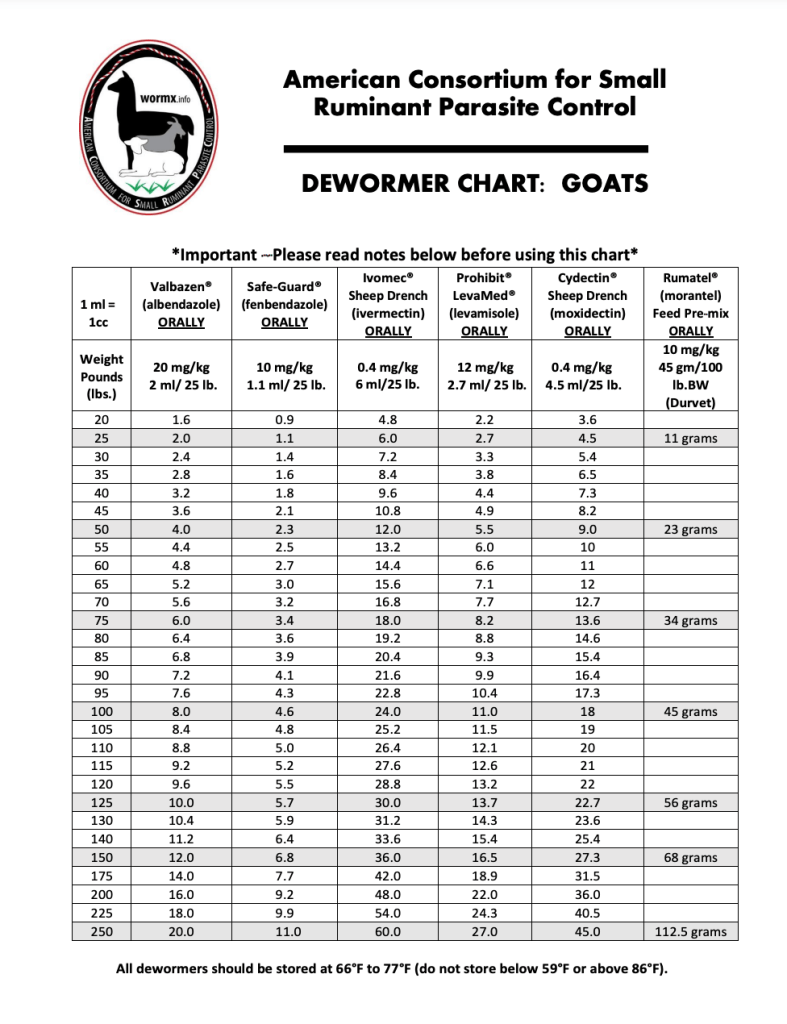
- Always follow the Updated Goat Dewormer Chart to determine dosages.
The following attachment is the ACSRPC Goat Dewormer Chart. Occasionally, for the wide-margin-of-safety dewormers, I will dose above the ACSRPC recommendations (especially for the benzimidazoles). It is important to follow the ACSRPC dosage if you need a guaranteed milk or meat withdrawal time. One final note: the use of drugs in an extra-label or off-label capacity requires a veterinary prescription and valid vet-client-patient-relationship.
CLICK HERE to access the chart.

 The Giving Goat, LLC