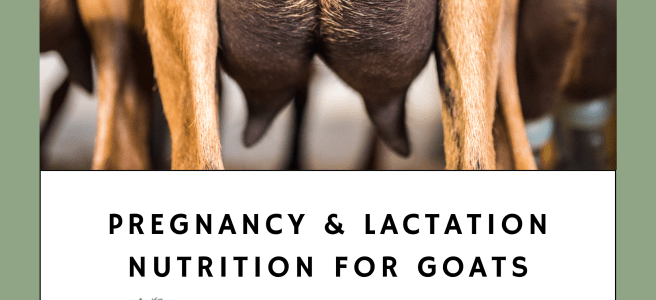
Feeding pregnant goats can be confusing, scary, and complicated for new goat owners (or those new to kidding)! While nutrition in general is a complicated topic, the nutritional requirements of pregnant goats aren’t too daunting, or too different, from the general diet requirements of a goat. If you haven’t yet read my article on General Goat Nutrition, please do so – as that describes the baseline of a pregnant goat’s diet. If you also have not read my article on Goat Minerals, I recommend checking that out as well, because minerals play a huge part in nutrition for pregnant goats! Today, you’ll leave this post with a much greater understanding of what your pregnant and lactating goats need!
All goats need high quality hay, fresh water, and loose minerals 24/7. This is plenty to keep most goats happy and healthy. Beyond this baseline, let’s discuss how nutrition changes when reproduction is involved…
Early Pregnancy
If your goat is under the desired weight, early pregnancy is the safest time to increase weight. If your goat is over the desired weight, it is a good time to note that and safely resolve it as the pregnancy progresses. Body condition aside, mineral deficiencies are usually the biggest concern. Due to how long it can take to resolve certain deficiencies, don’t put off supplementation until the last month of pregnancy. That may be a good time to give a booster, but if your goat requires selenium supplementation 1 month prior to kidding, your goat probably needed selenium supplementation well before that. Again, start by consulting my blog post on goat minerals (and deficiency identification), and then consult me if you need more help.
Once you know your goat is pregnant and you have worked to identify key issues, it is very important to add low to moderate amounts of alfalfa into the baseline diet. Alfalfa is a high calcium, moderate protein, high vitamin legume forage product. Calcium is an essential macro-mineral for pregnant and lactating goats (it is essential for all, but extra important for them). Many pregnancy and kidding problems can occur from a diet too low in calcium. But if you’ve read my blog for a while, or worked with me one-on-one, you know that I don’t always talk about calcium in such a positive light. Calcium is a mineral antagonist, just like sulfur, molybdenum (also a component of alfalfa), iron, and more. Mineral antagonists bind to certain minerals and hinder their absorption. And while this is thoroughly frustrating, they cannot always be avoided. Thus, when feeding alfalfa, make sure you feed the proper amount, in the correct balance with other minerals. Pregnant goats don’t need to be loaded up with alfalfa—you can feed it at low to moderate amounts depending on size and weight. For example, I usually work up to 1 cup per day for pregnant dwarf goats. This boosts their nutrition slightly without impacting them too much physiologically. It simply offers extra nutritional benefits to help the doe grow her fetus and prepare for lactation. You are welcome to offer alfalfa hay, and some goats may do very well on this—but if you struggle with mineral deficiencies, feeding a smaller sum of alfalfa via pellets is a better idea. Feeding alfalfa is not a guarantee that your doe’s calcium needs are satisfied. In fact, not all of the calcium in alfalfa is available calcium (the amount that gets absorbed can vary),
A note on alfalfa and hypocalcemia – in comparison to dairy cattle:
It is a common recommendation in dairy cattle to reduce calcium/remove alfalfa from the diet prior to parturition. Dairy cattle hypocalcemia is often due to low blood calcium associated with milk production. Problems with homeostatic calcium regulation and cationic balance are the causes of dairy cattle “milk fever.” In small ruminants, however, hypocalcemia is usually a result of insufficient dietary calcium due to fetus development. Dietary calcium should be increased for pregnant small ruminants, though the levels should still be reasonable and owners should aim to keep potassium levels low.
Mid-Pregnancy
If you have balanced the diet (mineral levels and quantity of alfalfa are all working well with your goat’s body) the long waiting game of pregnancy isn’t too complicated from here until late pregnancy. In fact, I recommend taking this time to get EXTREMELY excited about the bouncy, adorable baby goats soon to hit your farm (and steal your heart)! Keep your momma goat happy and healthy with proper management, and support her in any ways necessary for overall health.
Late Pregnancy
Approximately 1 month before kidding, things begin to change for your doe’s diet. This is somewhat of a personal choice, and you should consider what feed options you would like to provide for your goat throughout lactation. While you do not need to provide grain (your goat may do fine on alternative feedstuffs such as legumes, seeds, and more), grain is very helpful and healthy for lactation. The most simple option for grain is a well-balanced, 2:1 calcium to phosphorus, 14-16% protein, unmedicated goat pellet. Textured feeds are fine as well, but avoid anything too high in molasses (it will be very sticky), unless your doe needs more carbohydrates due to a history/symptoms of pregnancy toxemia. Another option is homemade feed. Presuming you adjust for proper balance and protein, this can be a good option for many operations. A standard, homemade blend of mine is as follows:
2 Parts Whole Oats
1 Part Rolled Barley
1 Part Mixed Field peas
Top with 1-2 TBSP Black Oil Sunflower Seeds or 1-2 tsp Flax Seed/Meal
Mix this half and half with alfalfa pellets when feeding.
Feeding grain during pregnancy isn’t usually the best thing for your goat—it can result in metabolic issues if fed improperly, and impact kid size. Grain should be introduced in small amounts 1 month prior to kidding. Ideally work up to only a cup (average example) just to get the rumen familiarized with grain, and then increase post-kidding.
Post-Kidding
Once a goat kids, you will then gradually increase the amount of grain and alfalfa fed. I almost always recommend feeding your grain in a 1:1 ratio with alfalfa pellets as a baseline, though sometimes even more alfalfa is needed. Increasing too quickly can result in stomach issues, so make sure to do it over the course of a few days. Some like to follow the rule of 1lb of grain for every 3lb milk produced, or you could follow a general idea of 2 cups alfalfa, 2 cups grain twice daily for dwarf goats (total 1 quart alfalfa and 1 quart grain per day), and twice that for standard goats. I usually try unfamiliar milkers on these standards and then adjust up or down based on how much they consume, how their body condition is, and how their production is. Those starting points usually work very well, but you may need to increase depending on weight and milk production, or decrease if you feel they aren’t finishing their ration, or they cannot handle that sum of concentrates. Always listen to the individual goat’s body.
Throughout Lactation
Throughout lactation, the diet should be what was discussed just above—adjustment as needed, sticking with the same general format. You should not need to add anything else or remove anything, unless, of course, your goat specifically needs extra weight and you start on a weight-gain program. Additions like beet pulp or calf manna may help a doe who requires more support to maintain good body condition, and this should be judged on a case-by-case basis.
To support milk production, there is a recipe available in my DIY Herbal Remedies for Goats eBook. “More Milk” is a helpful formula that you can make in your own kitchen using herbs that you grow or source to help support lactation. Click HERE to get it, and all 10 other formulas as well.
Drying Up
Drying up is an important part of feeding–it’s just the absolute opposite thought process of lactation! More feed = more milk… therefore, less feed = less milk. However, your doe still needs adequate nutrition, so you cannot starve her. Additionally, drying up is largely a supply and demand situation, even though diet has an impact. To begin the drying up process (at a time deemed reasonable by your own intuition and the goat’s natural way of lactation) you should begin to reduce grain. Now, if your goat is hypothetically already underweight, this can be difficult and counterintuitive to do. That is why it is so important to keep a goat in good weight during pregnancy and throughout lactation. DO NOT wait until drying off time to put weight back on a doe. Put weight on during lactation, when you can actually appreciate the increased milk yield that will occur from the increased feed. Assuming your doe is in good condition at the time of drying up, I recommend reducing grain first (keep alfalfa consumption normal). Feeding less grain will slow milk production, but the alfalfa will continue to help your doe hold good condition and maintain good health. If after a large grain reduction, your doe’s milk quantity has not changed, you can slowly reduce alfalfa as well. After a period of reduction, your doe’s diet should return to mostly hay. It should be low in concentrates, and thus she will have lower milk production. But again, reducing grain is only one step. You must also reduce the demand for milk. There is no one-size-fits-all schedule for how to lower the demand, as each doe will react differently. The most important thing to remember is that we are switching from the mindset of getting all the milk out to the mindset of simply relieving pressure. If your doe is being milked twice a day, instead of milking her out completely, just milk enough to relieve substantial pressure. If you continue doing this successfully, you can back down to only doing your pressure-relieving milk once a day. Then perhaps only every other day… you get the gist, I’m sure! But never leave a doe with a full, tight, uncomfortable udder no matter what your schedule says. Relieve pressure to keep your doe comfortable and free of mastitis. Some does, especially those with strong milking lines, will be stubborn to dry up. It is always a good idea to add helpful herbs to dry up a doe. I use Sage, Peppermint, Parsley, and Thyme (do not use these herbs on pregnant does). For a complete drying up herbal recipe with mixing and dosing directions, my “Get Dry” herbal formula and 10 more useful formulas are included in my DIY Herbal Remedies for Goats eBook, available by clicking HERE.
Email: thegivinggoat@gmail.com
Instagram via Direct Messaging: @goatlifegoodlife
Facebook Messenger: The Giving Goat, LLC
DISCLAIMER: I am not a veterinarian or licensed professional. The information shared here is based solely on my personal experience and is intended for educational and informational purposes only. It should not be considered veterinary advice, medical guidance, or a substitute for professional consultation. Nothing provided here is intended to diagnose, treat, or direct the care of any animal. Any decisions regarding your goats’ health, management, or treatment should be made in consultation with a licensed veterinarian. Goat care can vary widely based on individual animals, environments, and management styles. While I share what has worked for me, these perspectives may not be applicable to every situation. I encourage respectful, constructive discussion and recognize that each owner ultimately makes decisions based on what is best for their own herd.

 The Giving Goat, LLC