Different herds have different diets. This is something to remember as you ask around for advice, read articles, get mentors, or view all of those Facebook group posts asking “what should I feed my goats?” It’s normal for there to be variations in management styles. What works for one herd may not work for another, because so many factors impact nutrition. Luckily, I have some more detailed learning pods in this section to cover all of your questions. With that being said, there are some things that remain the same for relatively ALL goats. Let’s talk about the basics…
Goats theoretically only need 3 things to live:
- Hay (or another source of constant, long-stem forage)
- Water
- Minerals
So we are going to go deep into what I mean when I say those 3 simple words, and how they have meaning far beyond the simplicity of their names.
HAY
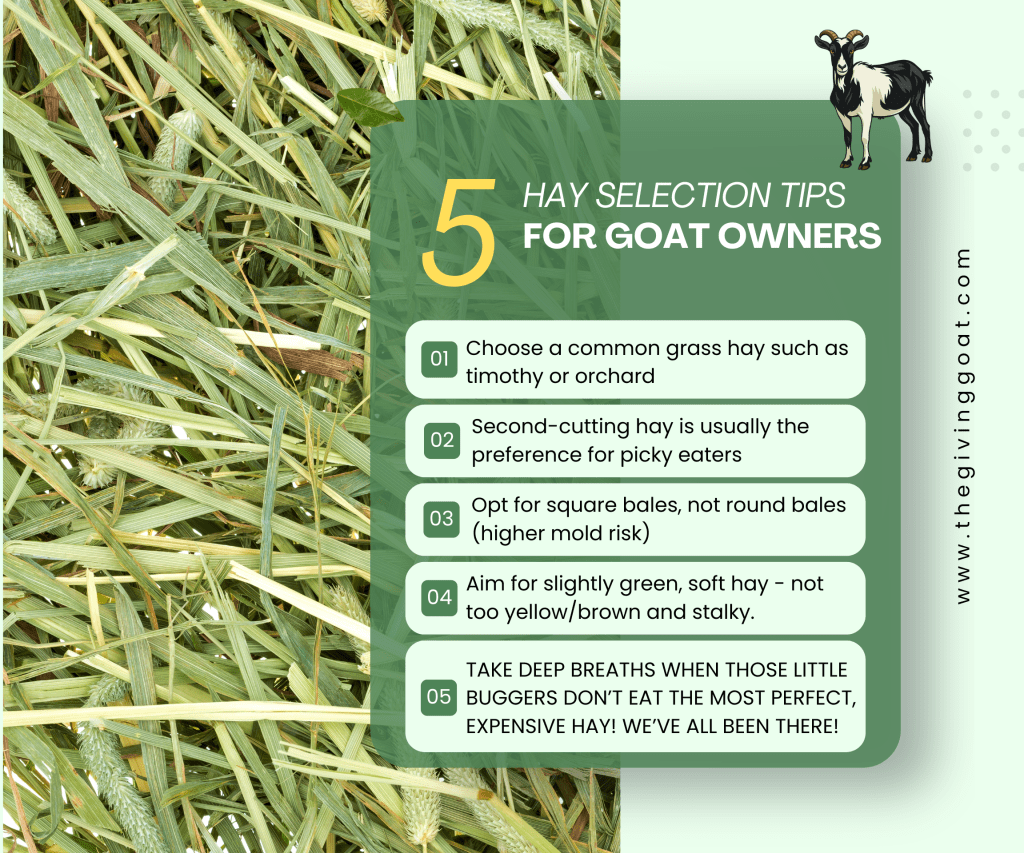
Hay is the staple of a goat’s diet (presuming that it doesn’t have access to 24/7 varied, nutritious forage such as acres of dense woods and pasture year-round). Good hay is a must. Hay sold as “goat hay” is often the worst choice for your goats. Hay farmers are usually not goat farmers, therefore they do not realize that goats are sensitive (and picky) creatures who need hay that is considered “horse quality” at minimum. High quality hay should not have moisture or molding (this can actually kill your goats), and ideally you want it to be green in color, not extremely yellow/brown. Sun-bleaching isn’t horrible, but we often say that good goat hay should be the color of money–a dollar bill. Since hay should be about 90-100% of your goat’s diet, it’s important that you choose your hay wisely.
Grass hay is the most ideal baseline hay. Orchard grass, timothy grass, and bermuda grass are some of the most common grass hay types. Sometimes mixed grass hays are sold, and these can be perfectly fine for your herd, but it is nice to have a nutritional idea of which grasses are present. Grass hay is the recommended baseline because it usually fits the needs of every goat–including male goats (see article on male goat nutrition for details). Other feedstuffs can be added to the diet along with grass hay, depending on individual needs.
Hay Selection Tips:
Some owners may choose to feed legume hay, such as alfalfa or peanut hay, if it matches dietary needs (see article on pregnant and lactating goat nutrition). Presuming it is a safe choice, these hays can be used instead of grass hay. However, there are considerations based on age, stage of life, sex, other nutrients/minerals, and more. Due to this, I still prefer adding legumes as supplemental feedstuffs (for example, alfalfa pellets in addition to grass hay) when needed.
So when I reference hay, I am talking about it as a staple of a goat’s diet. I would never let a day go by that my goats don’t have hay out for them 24/7. To determine how much hay to offer, put out hay by the flake and observe to see how much is consumed. You should put out slightly more than what is finished in an average day, so that there is always hay available. If it is within your management abilities, I recommend this observing and adjusting technique instead of putting out larger quantities that remain over many days/weeks, because goats prefer fresh hay daily.
WATER
While this may sound like an extremely simple part of a diet (and in many ways it is), the water you feed your goats can have a big impact on their health. Water should be available 24/7, and it should be clean and fresh. Buckets, troughs, or even automatic waterers are all great options.
The source of your water is the more important thing to discuss. Water may be from a well, a spring, or from your city, and the quality of it will vary. Some water is considered hard (especially common in well water). Hard water contains higher levels of certain minerals, primarily calcium and magnesium. Along with hardness, your water may contain higher quantities of minerals such as sulfur and iron. Each component can have an impact on the health of your herd. Most of these minerals are considered antagonistic minerals, meaning that they can block or hinder the absorption of some other vital minerals. Certain minerals can impact the absorption of zinc, copper, selenium, and more, causing deficiencies. Water cannot always be changed, but it is important to know what is in your water nonetheless. High sulfur and iron can be somewhat mitigated by RV attachment filters, such as the Horse Hydrator. Hard water might need to go through a softening and filtration system. If minerals are not filtered out or softened, you will need to adjust other parts of the diet to account for that. For example, if you have high calcium water, you may need to be more cautious of high calcium feedstuffs (like alfalfa), for both mineral deficiencies and urinary safety in male goats.
The mineral content of your water may also impact the efficacy of your mineral supplements, and dictate what minerals you need to offer your herd, and how.
MINERALS:
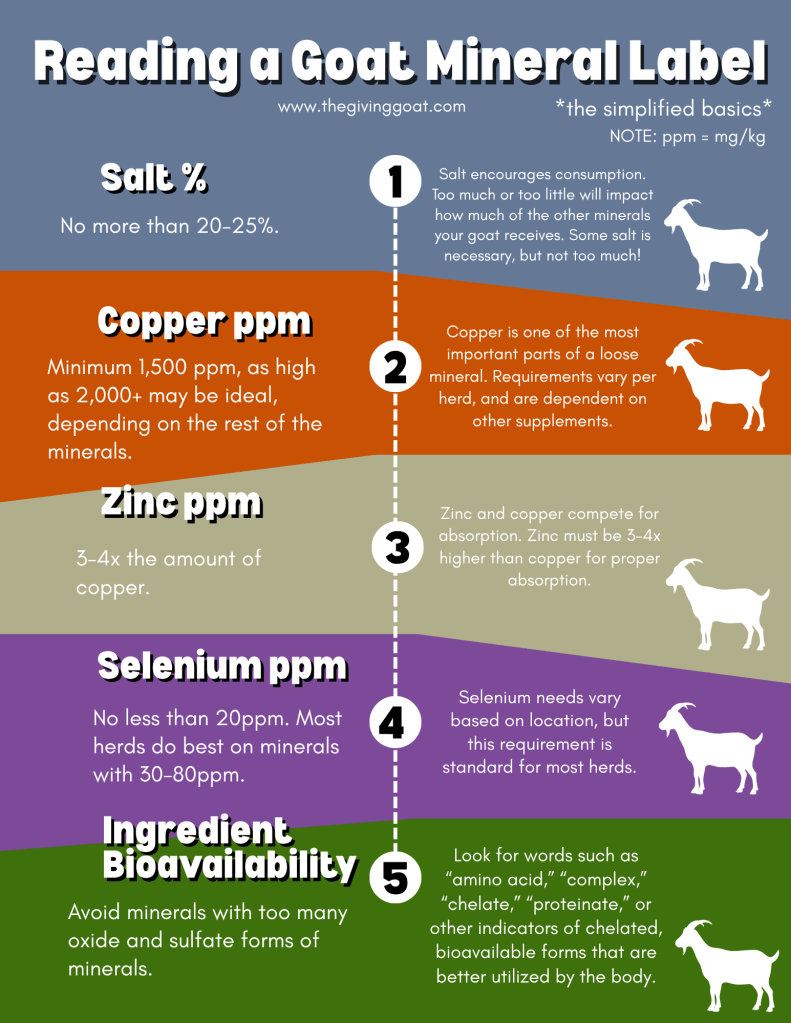
Minerals are the most complex part of the diet. You read a sneak-peek above, but minerals are extremely difficult to balance. For a more comprehensive perspective, see the article on mineral nutrition. As a baseline, goats should have 24/7 access (free choice) to a high quality loose mineral blend. Loose minerals are required as opposed to blocks. Unlike cows with their rough tongues, goats cannot get the necessary nutrients from blocks. Additionally, blocks are usually formulated with too much salt or fillers for goats. There are many brands of loose minerals, though not all are created equal. It is important to learn how to read and understand a mineral label to determine if it meets the needs of your herd. Here is a helpful cheat sheet:
Cafeteria-style buffets are increasingly popular, but I have significant concerns and do not recommend the method at this time. I am a firm believer that more research is always a good idea, and I welcome hearing about experiences using the buffet, but you can read my updated thoughts and concerns in my blog post: Are Mineral Buffets Right for All Herds? Pros, Cons, and Thoughts.
As always, if you are unsure how to conduct a basic mineral analysis, feel free to send an email or message on social media, and I would be happy to chat with you and explain to the best of my knowledge how it works!
Sometimes, a loose mineral is not enough and other supplements are needed. This can range from free choice kelp meal or other salt supplements to copper boluses, mineral pastes, and more. All of this is discussed in my detailed mineral nutrition article.
Hay, water, and minerals are the three main parts of a goat’s diet. Now, let’s discuss additional feedstuffs…
GRAIN/FEEDS
Overfeeding grain is a common new owner mistake. The attractive bags of goat pellets in the store combined with the feeling of your goats being absolutely obsessed with you because of the delicious treat you carry can result in owners overfeeding grain. Male goats are particularly at risk, because grain is a leading cause of urinary calculi (urinary stones). However, any goat can overeat grain leading to bloat, acidosis, and even death. It is important to think of grain as a supplement for particular situations only.
While grain (generic term I will use for anything that is made from cereal grains–either a store bought blend, homemade blend, pellet, textured, or beyond), is not necessary in the baseline diet, adding grain can be helpful for certain goats. For example, a goat in lactation requires significantly more calories, protein, and carbohydrates to produce. Grain (and legumes like alfalfa) is a top recommendation for lactating goats to ensure nutritional needs are met. Please see my article on nutrition for pregnant and lactating goats for more information. Young/growing kids may also benefit from grain. While most people think this is only to support growth due to increased protein and calorie requirements, grain is also helpful for the development of the rumen. Research has shown that feeding grain aids in the development of rumen papillae. The fermentation of the starch in grain increases VFA (volatile fatty acid) production, which encourages more surface area expansion. The more surface area (better developed papillae), the better the digestion/nutrient absorption for the goat. This can have a lifelong impact. With that being said, goats on a grain-free diet will still grow, develop a microbiome, and have satisfactory rumen papillae. Allowing a reasonable level of starch fermentation with a small amount of grain can be beneficial to development and microbial diversity, but is not a requirement.
Alfalfa is another common addition for growing, pregnant, and lactating goats. The importance of alfalfa is discussed in my article on pregnant and lactating goat nutrition. Put simply, this is a staple of a reproductive-oriented diet. For non-production goats (pets), alfalfa can be a safe treat in moderation. Additionally, growing goats, alfalfa is often a useful, high protein addition. Things get a bit more complicated when we start discussing male goats, because alfalfa is usually not recommended for them, but may be necessary to balance high phosphorus in rare scenarios where boys require more protein/calories (such as when recovering from weight loss).
GRASS/FORAGE
Having a bit of grass or forage for your goats is a nice addition to a diet. The amount of forage available is rarely enough to provide a complete diet, but is a wonderful thing to have available. If your goats don’t have forage in their pasture, you can go out and cut some for them and put it in their enclosure. Just make sure all plants/trees are safe for them to eat. As for grass, do not assume that goats are like horses and will graze all day. If your goats graze, it will be sparingly, presuming they have access to hay. Goats much prefer weeds, trees, branches, and other “browse” products. Do not rely on grass as a big part of your goats’ diet, even though it is a welcome addition. And remember, with pasture comes more opportunities for parasites to reproduce and reinfect your herd, so be sure to consider parasite management in your diet plan.
TREATS
Last but not least—treats! Every goat needs a bit of excitement or food-related praise, and most goat owners love to spoil their goats with snacks! I try to keep treats to a minimum. This is a very small part of a goat’s diet, but every once in a while goats like some variation and something fun to eat! Fruits and veggies can be given, but my go-to is timothy hay pellets (sold for horses). These are low calorie and can be fed without concern for causing weight gain. They are also balanced for boys, in terms of urinary calculi risk. Remember to check if each food is safe, and feed caloric or sugary treats in moderation.
Overall, balance is essential. Every aspect affects the other. It’s important to be informed about each and every part of your goat’s diet. Keep it simple, and know what you’re feeding!
Email: thegivinggoat@gmail.com
Instagram via Direct Messaging: @goatlifegoodlife
Facebook Messenger: The Giving Goat, LLC
I am not a veterinarian or licensed professional. The information shared here is based solely on my personal experience and is intended for educational and informational purposes only. It should not be considered veterinary advice, medical guidance, or a substitute for professional consultation. Nothing provided here is intended to diagnose, treat, or direct the care of any animal. Any decisions regarding your goats’ health, management, or treatment should be made in consultation with a licensed veterinarian. Goat care can vary widely based on individual animals, environments, and management styles. While I share what has worked for me, these perspectives may not be applicable to every situation. I encourage respectful, constructive discussion and recognize that each owner ultimately makes decisions based on what is best for their own herd.

 The Giving Goat, LLC