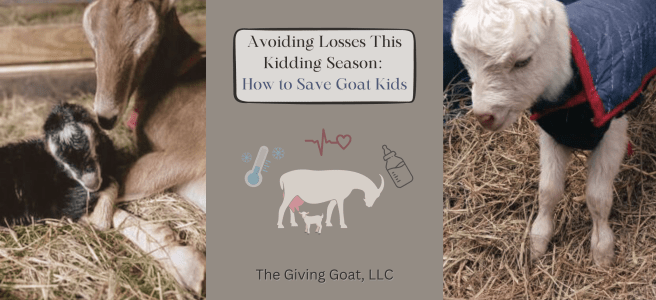
Kidding season is one of my busiest times for emergency consults—probably a close second to the height of parasite season! For those of you who don’t know me, I’m Hannah, Founder of The Giving Goat, LLC. I’m a Professional Goat Care Consultant/Natural Goat Care Mentor, farmer, and friend. You probably see my blog posts, quick tips, and Q&As throughout social media. What you don’t see as frequently is the behind-the-scenes emergency and continuous support I provide to owners struggling with many different goat care woes. From the start of kidding season through weaning, I work every day, all day (and sometimes even the middle of the night) to help owners give goat kids the best chances of survival. If you go on Facebook groups for goat emergencies (which I don’t usually recommend) you will see a plethora of weak/failing-to-thrive kids throughout kidding season, and due to the massive amounts of posts and inexperienced ‘helpers’ making recommendations, there are a lot of losses in the goat community during this time. Many of these losses are preventable if met with the right knowledge and care.
While I am currently gearing up for the inevitable emergency kidding season consults, I’m confident that once you read this post in detail, you’ll be able to get ahead of common problems that arise, especially if I cannot be reached immediately (kids go downhill very fast—minutes matter). Let’s give your kids the best chance to thrive! Losses happen, and not all kids can be saved, but it’s my job to prepare you to save fading/ill kids to the best of your ability. Of course, I suggest that you still reach out for a consult at the earliest sign of a problem, so we can work through it together. I am available via email, Instagram, and Facebook messenger. And yes, you can message me on Christmas Eve, New Year’s Day, weekends…all of the above!
Before getting started, remember that having the supplies you need on hand is crucial. I have a general first aid kit & supplies list, detailed birthing lists that I give to my clients, and a special list for this post focusing on some of the basics…
Click HERE to download my NEWBORN LIFELINE KIT list!
Here’s The Deal…
Concerning any urgent medical situations with kids, it’s important to always prioritize supportive measures. Supporting a kid is a matter of life and death. While I will discuss diseases/illnesses/disorders, a lot of issues simply stem from lack of support. Support comes down to the three main factors for keeping a kid alive: keeping them warm, keeping their blood sugar stable, and keeping them fed. Now, to elaborate on these three vital factors…
Warmth/Hypothermia
Body temperature should remain between 101.5 – 103.5. It is not uncommon for a kid to become chilled, especially soon after birth. Please use a digital thermometer to take the temperature of a kid rectally. However, if doing a rushed analysis, a cold mouth and tongue is a good indicator of a low body temperature as well. Hypothermia can lead to death if not treated quickly. When a kid’s body temp is low, their body ceases to function. Whether or not there are other issues going on is not a concern while hypothermia is occurring. The only concern should be getting the kid up to a stable temperature—you can resolve other issues afterwards.
To warm a chilled kid, there are a few different options, but this is my preferred step-by-step method:
*An immediate dosing of cayenne pepper powder combined with honey should be rubbed on the kid’s gums while the warming procedure is set up. Cayenne will warm and shock the body back into action, helping with circulation and organ support as well. The honey provides a quick glucose boost while the rest of the warming procedure is set up…more on glucose shortly.
1. Fill a sink or a bathtub with warm water to maintain ~104 degrees Fahrenheit.
2. Place the kid in a large plastic bag or a trash bag with their head out (just wrap the bag around their body to protect them from getting wet).
3. Submerge the kid’s body into the water bath.
4. While in the bath, you can repeat the cayenne and honey, or carefully syringe (if able to swallow) with the glucose drip recipe given in the next section.
5. The kid can be removed from the bath and transferred to an alternative heat source if improvement has been made. NOTE: Your body, or a blanket, does not count as a heat source. The human body runs much colder than goats do. A heating pad can work, though I tend to prefer the technique of running a few towels in a dryer until hot, then wrapping the goat in one towel, placing the kid back in the dryer (turned off, ensuring no hot metal is exposed and the kid is well wrapped), and then leave the dryer door slightly ajar, allowing the kid to breathe in warm air as well as experience the warm towel wrap.
6. If no other issues arise and the issue was simple hypothermia from cold weather, a heat lamp/warming barrel setup in the barn and frequent check-ins are usually all that is needed for aftercare.
7. NOTE: In severe cases, a warm water (102-103) enema can also be given to provide internal warming along with the other measures.
Blood Glucose/Hypoglycemia
This issue is highly connected to the issue of hypothermia, and it is also one of the reasons why honey is something I recommend in the start of the warming process. Kids can fall into a hypoglycemic state—suffering from low blood glucose—as a secondary issue to being chilled, weak, or unable to consume enough food (this will be discussed next). If you have ever seen a kid appearing neurologically impaired, experiencing seizing or even death after a seizure, this is frequently due to hypoglycemia. Keeping their blood glucose levels stable is vital, and it goes hand-in-hand with emergency warming. If a kid is warmed while in a hypoglycemic state, this can lead to seizing, and that is why warming measures should always be accompanied with honey or other forms of glucose. The cayenne and honey on gums is a start, but you can also begin a glucose drip (dosing of liquid via syringe slowly but surely, so as not to cause aspiration). A DIY glucose drip can be made with common household items.
Glucose Drip Recipe:
Choose one (listed in preferred order): 5cc of Honey, Karo Syrup, Maple Syrup, or Molasses.
Combine chosen form of glucose with 5-10cc of warm water and maintain 102-103 degrees F for dosing. The amount of water depends on the thickness of the chosen syrup. Keep glucose drip in warm water bath until ready to dose.
This is called a drip because you can administer it slowly via mouth, so as not to aspirate a kid. Don’t shoot it down their throat like a normal drench, as they are usually too weak to swallow liquid that quickly. The more that goes in, the more they will perk up, and the faster you can dose it.
The solution can also be given via tube feeding.
If the kid is in an extremely weak state and has lost consciousness, an IP injection of Dextrose 50% solution is the best way to reverse severe hypoglycemia. For information on IP injections, which are very different from normal SubQ and IM injections, as well as a stomach tubing, please see this link from Cornell: https://cals.cornell.edu/nys-4-h-animal-science-programs/livestock/goats/goat-educational-resources/tubing-and-ip-injections
Milk Consumption/Starvation
This is connected to both hypothermia and hypoglycemia. A goat that has not consumed the proper amount of milk will not be able to hold their body temp nor the proper blood glucose levels. An underfed kid can be caused by many things, including: a dam who has rejected the kid, a blocked teat or case of mastitis, a weak suckle reflex, low mobility due to deformities, and low energy due to being chilled. A kid who is on the edge of hypothermia and hypoglycemia sometimes just needs a good warm feeding of milk or colostrum. Know how to tube your goats, as this can be an even better alternative to bottle feeding (especially if you plan to put the kid back on their dam, as the tube won’t confuse them like a bottle can).
The most vital thing for your newborn to consume as soon as possible is colostrum. Whether this colostrum comes from their mother, a donor goat, or replacer (if absolutely necessary), your kid will likely not survive if they do not receive the proper amounts of a correct form of colostrum in their system early on. Colostrum should enter the kid’s system within the first few hours of life. I have seen many cases of kids being unable to nurse due to a weak suckle reflex or other issues, yet owners do not realize how important it is that they force colostrum into the kid to get all of those natural instincts jump-started.
*Even if your kid cannot suckle, you must force colostrum into them, often via tube feeding to the stomach, no matter what.
The only exception is if the kid’s body is under 100 degrees, in which case they should be warmed prior to feeding (a kid should NEVER be fed with a severe sub-temp, as their body cannot process the milk).
The amount of colostrum required depends on the kid. If a healthy kid is suckling correctly on their dam, you can usually trust that they are consuming enough colostrum as long as you confirm she has good flow (no blocked teats), the kid’s belly begins to feel fuller, and you observe frequent nursing.
If you are responsible for the administration of colostrum, you may need to adjust to the size of the kid and how much their belly holds comfortably, but a good reference point is ensuring that the kid consumes between 10%-20% of their body weight in oz of colostrum in the first 24 hours of life (15% is usually a good goal). However, the most important colostrum consumption is in the first 6 hours of life, where the goat should get at least 5% of their weight in oz to get a good start. A newborn will usually require a feeding of colostrum every 2 hours. To understand how to do these calculations, see my guide below.
Calculating How Much Colostrum to Feed (with an example kid weighing 3lbs):
1. Get the kid’s weight.
2. If in lbs, multiply by 16 which will tell you the weight in oz.
3. Multiply the kid’s weight in oz by 0.05
(3lb x 16 = 48oz) (48 x 0.05 = 2.4oz)
4. That total number is the amount of colostrum the kid should ideally receive in the first 6 hours of life. Not all goats are the same, and some colostrum is always better than none, but sticking to these mathematics is recommended.
5. Take the total number and divide it by 3 (colostrum is required every 2 hours in the first day of life. In the first six hours, that means there will be 3 feedings).
(2.4 / 3 = 0.8oz)
6. This number is the amount of oz you will feed per feeding for the first 3 feedings of life. If your kid is very small, you may need to split this into more than 3 feedings. That is perfectly fine, so as not to overwhelm their tummy. If your kid is very large, and seems to want more colostrum, you can also readjust your calculations.
7. After the first 6 hours, you will then alter your calculations to either a 10%, 15%, or 20% model. Smaller kids may do better closer to a 10% model, and larger kids may happily take to a 20% model. You can adjust anywhere between these two numbers. I usually aim for 15%. This means that your calculations after 6 hours of age will change to what follows in the next steps.
8. Get the kid’s weight.
9. If in lbs, multiply by 16 which will tell you the weight in oz.
10. Multiply the kid’s weight in oz by your % in decimal form (in this case, I choose .15)
(3lb x 16 = 48oz) (48 x .15 = 7.2oz)
11. Subtract the amount already fed in the first 6 hours from this total
(7.2 – 2.4 = 4.8oz)
12. This is the total amount of milk needed for the rest of the 24 hour period (now 18 hours)
13. Divide this number into amount of feedings (every 2 hours for 18 hours = 9 feedings)
(4.8 / 9 = ~ 0.5oz)
14. Therefore, this 3lb kid will need about 0.5 oz per feeding of colostrum.
I hope the math lesson here is helpful, but if you continue bottle feeding regular milk past 24 hours due to an issue with dam or kid, feel free to use my regular bottle feeding chart for pre-calculated amounts!
What Else Do You Need To Know?
Aside from the three main factors that are life-or-death for kids, there are plenty of other issues that can lead to illnesses or death for goat kids. Diving deeper into some of them, I’ve also organized them in a loose chronological order of when they may appear (from immediately at birth through early life).
Defects
Genetic defects can occur in kids in the form of incorrectly formed organs, heart murmurs, or musculoskeletal defects in the palate or extremities. Many kids that are born with fatal internal physiological defects do not make it long past birth (or are stillborn). Unfortunately, most owners can only attempt to make goats with untreatable defects comfortable and minimize distress. If a kid passes suddenly after seemingly failing to thrive, there is a good chance you have done nothing wrong and you could not have prevented the issue. Mild heart murmurs can resolve with age and proper care, defects of the palate can be surgically repaired, and defects of the extremities may be due to genetics or deficiencies, and are either repairable or manageable in most cases.
Mineral Deficiencies
Selenium deficiency is a very common cause for kids to be born weak, deformed, or failing to thrive. There are many warning signs of selenium deficiency in a doe that may help you differentiate a selenium deficient kid from a weak kid due to other causes, and you can see more about that in THIS post. A selenium deficiency is often the precursor to hypothermia or starvation, as selenium deficient kids do not hold their body heat as well and they often have trouble consuming proper amounts of milk (i.e. from an improper suck reflex, a common sign of selenium deficiency).
Aspiration/Pneumonia
Aspiration can occur due to birthing fluids, or from milk in kids who are bottle-fed or dam-raised, but more often in bottle-fed kids. This can turn into aspiration pneumonia, but pneumonia can also occur in young kids due to other reasons. My preferred method of treating pneumonia (if using conventional medicine) in a young kid is using the antibiotic Draxxin (can be given along with Nuflor or another antibiotic if necessary). I like Draxxin for neonatal pneumonia because I feel that it reaches the lungs in a faster manner than many other antibiotics do. The dosing for Draxxin is usually 2 shots, 7 days apart—but if using it on its own, a third shot on day 3 is recommended. For natural treatment options, consult with me personally on a situational basis. Pneumonia can come with the usual respiratory symptoms or silently (without obvious symptoms). However, many are quick to assume pneumonia is causing illness or death in young kids when the issue is actually related to one of the first three problems I discussed—and that is often because they are thinking of the situation as they would if it were an adult goat. The thought process needed to diagnose and treat an ill kid is very different.
GI Illnesses — Enterotoxemia and Floppy Kid Syndrome (FKS)
Many issues of the digestive tract in kids are due to the overfeeding of milk. In dam-raised kids, this is not a common issue. However, a doe with very rich milk and a large kid who is consuming a lot of milk can be a precursor to this issue just as often as bottle feeding is. Enterotoxemia is a gastrointestinal disorder caused by an overgrowth of harmful bacteria in the rumen. This bacteria always lives in the rumen but it is in a careful balance with the other microbes. The ‘good’ bacteria keeps the ‘bad’ bacteria at bay. When the ‘bad’ bacteria overgrows, specifically Clostridium perfringens, fatalities can occur and will usually present in the form of stomach pain, loss of appetite, and profuse diarrhea (often watery and bloody). Treatment should be a cleansing of the toxins in the stomach via activated charcoal and milk of magnesia, and dosing of the CD Antitoxin. Antibiotic therapy (often oral penicillin in pre-ruminating kids ONLY) may be necessary, with supportive therapy of B vitamins, fluids, and probiotics after antibiotic treatment as well.
Floppy Kid Syndrome is very similar to Enterotoxemia. Floppy Kid Syndrome is often confused for weak kids or kids suffering from some of the initial issues I discussed, like hypothermia or selenium deficiency. However, FKS is a very specific disease. FKS is usually brought on by metabolic acidosis and electrolyte imbalances from improper milk digestion. It has a relationship with microbial imbalances and therefore FKS can be a precursor to or go hand-in-hand with Enterotoxemia. The symptoms of FKS include weakness, recumbency (inability to stay upright), paralysis (including a rag-doll, “sprawled out” weakness of the back legs), and going into a deep sleep state with difficulty waking up, but the early symptoms can be simple ataxia (wobbliness). Diarrhea is not common, but is often a good sign that the goat’s body is clearing out toxins and it should not be stopped with anti-diarrheal medication. The treatment for FKS can include milk of magnesia and the CD Antitoxin just like Enterotoxemia treatment, but the most important thing with this disease is to dose baking soda (usually 1 tsp combined with 8oz water, dosed at 10-20cc) and pull the kid off milk immediately. The kid must remain off of milk for 24-36 hours. Instead of milk, feed balanced electrolytes formulated for goats. Feed electrolytes the same as you would milk—same amounts, same frequency, heated to the same temp. Goat kids can go a couple of days on electrolytes without milk if they must, so do not be afraid to withhold milk while they recover for at least 24 hours minimum. Occasionally either of these issues cause constipation, so a correctly-given enema can be a useful tool for support in treating both issues. Oral antibiotics in pre-ruminating kids may be included in the treatment of FKS, but usually are not required. Constipation may occur, and an enema can be used as needed.
*Important to note: these diseases take a bit of time to occur, so newborns will not be born with it, and goats only a day or two old are unlikely to be suffering from it. But by 3-10 days old, this is a possible problem when symptoms match!
Overfeeding
Before it turns into something like FKS or Enterotoxemia, overfeeding is still a big issue to discuss. It can cause diarrhea, bloating, discomfort, and eventually death due to the more severe problems that follow. The most common symptom of overfeeding is milk scours (loose stool caused by improper milk feeding). It will almost have the appearance of undigested milk, often white or pale yellow in color. The goat’s vitals should be otherwise normal. If scours are not present, teeth grinding or a hard, distended belly are also common signs of overfeeding. Be very careful not to overfeed bottle kids, as they will continue to act hungry even when they have consumed the correct amounts of milk. If, at any point, overfeeding has been suspected, a “tummy reset” of electrolytes for 12-24 hours in place of milk can help balance things out!
Do not be fooled by the term “bloat” in young kids. I can’t even count how many times I have seen someone ask a question on a public goat group about a kid acting lethargic, grinding teeth, with a round belly…and all the comments are saying “it’s bloat!” “treat for bloat!” I usually only use the term bloat in reference the illness of bloat (not the physical appearance) caused by excessive gas buildup in the rumen. These gasses are a by-product of fermentation. In pre-ruminating kids, they aren’t producing the same gasses that older goats do. While they do have some microbial presences beginning to occur, don’t confuse the acidosis they may experience from overfeeding of milk, electrolyte imbalances, or bacterial toxins, with simple gas buildup. Luckily, most of the recommended treatments for gas bloat coincidentally help these other issues—such as baking soda. Even oil may help if the kid is constipated due to overfeeding. But that really is just “dumb luck,” because if people continue to use the term “bloat” so freely, young kids could be mistakenly given bloat medications or other gas bloat treatments based on confusion or improper googling.
Vitamin B1 Deficiency
The most important vitamin deficiency that causes losses in goat kids is Vitamin B1 (thiamine) deficiency. This deficiency causes Polioencephalomalacia or “Polio,” a neurological illness. This occurs in adults due to various reasons (see THIS post), but it is actually very common and often overlooked in kids. Because thiamine is produced in the rumen, and goat kids don’t begin ruminating immediately after birth (and even once they begin ruminating, it isn’t nearly as strong and functional yet!), newborn and young kid Polio is common as they are not producing thiamine as fully ruminating goats are. This neurological illness can sneak up on kids and can be triggered by multiple factors. The symptoms in kids are the same as in adults (once again, see THIS post), and the treatment is also the same. As a reminder, this illness is a common after-effect of other illnesses, and because kids don’t produce thiamine as effectively, it isn’t a bad idea to add this vitamin whenever there is a concern for the health of a kid, as it’s one of those vitamins that can be given in a “better safe than sorry” context.
Tetanus
Tetanus can occur from common goat kid procedures such as disbudding, castration, and tattooing. Tetanus causes rigidity, leg stiffness, lockjaw, stiffened erect ears or tail, and other neurological symptoms. While vaccination for tetanus is the common preventive practice, I recommend utilizing the tetanus antitoxin selectively and thoughtfully as well. The CD&T vaccine, like most vaccines, triggers an immune response to the pathogen/toxoid. In very young kids, I personally feel the vaccine lacks proper efficacy due to their immune systems not being very well-developed. I believe that the vaccine should not be given prior to 8 weeks of age if you want to achieve proper effectiveness. However, many procedures occur before 8 weeks of age, like disbudding. Thus, giving the tetanus antitoxin at that time for short-term protection is what I recommend. Once the goat is 8 weeks of age, the first dose of the vaccine could be given, with a booster 21-28 days later, if you choose to vaccinate your goats. If you do not want to vaccinate your goats, I still consider the antitoxin (which is not a toxoid) a requirement to use at disbudding and castration, and to keep on hand for the future! Tetanus is best prevented, rather than treated, as the treatment prognosis is poor. The antitoxin, antibiotics, and supportive therapy are the treatments for tetanus.
Joint Ill
Joint Ill isn’t one of the most common causes for losses, but I do see it in my emergency consultations most years during kidding season, so it’s worth discussing. Joint Ill, also called Navel Ill, is an infection that begins in the umbilical cord (often when it is not properly dipped in iodine), where bacteria enters the umbilical cord and eventually causes infection throughout the entire body, characterized by the swelling of joints. Symptoms include swelling or heat in leg joint(s), lameness, high fever, and possible loss of appetite. Swelling or heat at the site of the navel is also common. Based on my observations, this illness can occur as early as 3 days and as late as 3 months+. Treatment includes a strong antibiotic, such as Baytril 100. Other antibiotic options (which are not preferred—only use if you really cannot get Baytril) are Excenel, Penicillin, Oxytetracycline, or Nuflor. Vitamin C can also be given for extra support and other herbal therapies for liver/kidney support and blood cleansing due to the sepsis are also recommended. Please reach out to me if you are dealing with suspected/confirmed Joint Ill.
Bacterial Scours
Bacterial scours can occur from E. coli or Salmonella bacteria, and are especially common in young kids. If scours occur but the goat is too young for parasites to be the cause, and it is clear that it is not dietary (milk scours are usually white or pale yellow, and easy to identify), then the cause for scouring may be bacterial. In kids only a couple days of age to kids a few months old, bacteria should always be considered as a cause for scours when symptoms match. Usually bacterial scours are accompanied by a fever. The scours will be extremely foul smelling in most cases. Most notably, the color of the scours can indicate a bacterial issue. If scours are black and tarry (do not confuse with meconium right after birth), bright yellow (not to be confused with the normal, harder, mustard-colored stool the first few days of life), bright green, or gray, a bacterial cause is likely. The most common treatment is Neomycin or Spectoguard. If you do not have access to these or a veterinarian who could prescribe them in an emergency, ensure that you have natural measures on hand for immune boosting and support—including the vital formula, HerBiotic, from Fir Meadow LLC. Keeping the kid hydrated is important as well. If you have no success treating bacterial scours naturally, seek a vet for the conventional meds if you cannot get your hands on them yourself (Spectoguard was once OTC, now switching to prescription, but can still be purchased in some places).
Parasites
Parasites are a substantial cause for kid losses. Usually at around 21-30 days of age is when parasite issues burst into a crisis. Coccidiosis is the most common parasite issue I see in young kids and you should be aware of the symptoms, treatment, and prevention of coccidia. See THIS link! Your kids can be started on herbal deworming formulas at 4 days of age—see THIS link for more details.
Well, I should probably stop myself before I go on and list 100+ more illnesses, because these are the most common and dangerous ones that I want to remind you all of going into kidding season. Remember the 3 most important factors for kid stability and support: stable temperature, stable blood glucose, and staying fed!
Please see THIS link for a more detailed explanation of some newborn situations (including kids born weak or nearly dead) and how to solve them, with doses included.
For any further information, please contact me via any platform. For emergencies, I am also available throughout kidding season via the platforms below!
Instagram – @goatlifegoodlife
Facebook – The Giving Goat Natural Goat Care & Blog
Email – thegivinggoat@gmail.com
DISCLAIMER: I am not a vet, nor am I a licensed professional. I am in no way a “goat expert” and my opinions are only that of personal experiences, and my insights shared are not medical treatment suggestions, care suggestions, or any directions for raising goats at all. I am simply sharing my own personal opinions. Any and all changes to your goats’ health regimen, care, etc. should be approved by a veterinary professional or licensed professional. I also believe that every goat owner has their own way of doing things, so just as my opinions are my own, and cannot apply to anyone else, your opinions are also regarding your individual goats, and I welcome you to share them in a kind, constructive manner.

 The Giving Goat, LLC